

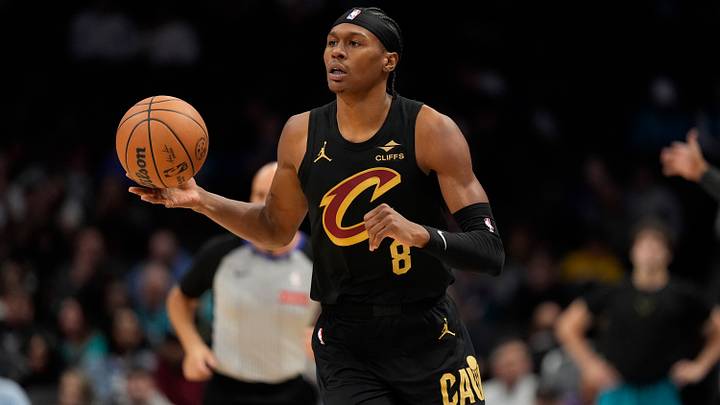
The Cleveland Cavaliers spent $88 million on Peyton Watson, and right now, they're paying an awful lot for defense and wishful thinking. Cleveland didn't need another player whose offensive contributions come and go. It needed a dependable two-way wing, and Watson was supposed to be the answer. Instead, his first few weeks in a Cavaliers uniform have made that hefty investment difficult to justify.
Watson arrived in August through a sign-and-trade with the Denver Nuggets, signing a four-year, $88 million deal that pays him approximately $20.5 million this season. Cleveland also parted with Max Strus and an unprotected 2031 first-round pick as part of the larger transaction, making this considerably more than a routine offseason acquisition.
The Cavaliers clearly saw something worth paying for, and Watson's arrival addressed a major need. Unfortunately, the player who impressed everyone in Denver hasn't quite made the trip to Cleveland.
Peyton Watson's offensive production has taken a serious hit
Watson gave the Cavaliers plenty of reasons to believe they were getting a bargain. During his final season with Denver, he averaged 14.6 points, 4.9 rebounds and 2.1 assists while shooting 49.1% from the field and an impressive 41.1% from three-point range. For a young forward known primarily for his defense, those numbers suggested his offensive game was finally catching up.
Cleveland has gotten a very different version of Watson.
Through his first 12 games, he's averaging 10.7 points, 4.5 rebounds and 2.5 assists while shooting just 37.5% from the field. His three-point percentage has fallen all the way to 23.1%, despite attempting more shots from beyond the arc than he did in Denver.
That's a pretty dramatic drop for someone whose improving shooting helped earn him an $88 million payday. Watson hasn't suddenly forgotten how to play basketball, and his 1.5 blocks per game show that he's still capable of making a difference defensively. But Cleveland paid for more than a good defender.
The Cavaliers were counting on Watson to stretch the floor, finish efficiently and give Donovan Mitchell another reliable offensive option. Instead, he's making fewer shots while taking up a significant chunk of the payroll.
Watson's contract looks even worse compared to other NBA players
Here's where Cleveland's decision gets particularly frustrating. Watson isn't being paid like an inexpensive developmental project. He's earning the kind of money that other teams are spending on established contributors.
Josh Hart, for example, makes approximately $20.9 million with the New York Knicks. Hart averaged 12 points while shooting 50.8% from the field and 41.3% from three last season, and his rebounding, playmaking and versatility have made him an invaluable part of New York's rotation.
P.J. Washington earns approximately $19.8 million with Dallas, while Dillon Brooks makes around $20 million with Phoenix. Both have established themselves as physical, dependable defenders who can contribute offensively without needing the entire game plan built around them.
Then there's Alex Caruso, earning roughly $19.6 million with Oklahoma City. Caruso isn't a prolific scorer, but he's a proven championship contributor whose defensive instincts and ability to make winning plays are well established.
These players aren't identical to Watson, and they don't need to be. The comparison is about what teams are getting for their money.
Cleveland is paying Watson more than Washington, Brooks and Caruso, yet his current offensive production is nowhere near what the Cavaliers expected when they signed him. Even Christian Braun, another former Denver wing with championship experience, is earning only about $1 million more this season.
That's a tough collection of names to look at when your $88 million acquisition is shooting 23.1% from three.
The Cavaliers can't afford to spend this much on potential
Watson's age is an obvious selling point. He's only 24, and Cleveland signed him with the expectation that his best basketball was still ahead of him. That's a perfectly reasonable approach for a rebuilding franchise, but the Cavaliers aren't rebuilding.
They're trying to win a championship with Mitchell in his prime and James Harden approaching the final stages of his career. Cleveland needs players who can help it win now, particularly after committing so much money to an already expensive roster.
And that unprotected 2031 first-round pick makes the decision even more consequential. Cleveland surrendered a valuable future asset because it believed Watson could help solve a problem today.
There's still time for Watson to rediscover the shooting touch that made him attractive in Denver, but that doesn't change the assessment of what he's delivered so far. The Cavaliers made a major financial commitment to a player whose early production hasn't matched the price.
Right now, Peyton Watson hasn't been a good investment for Cleveland. His defense is useful, but $88 million and a valuable first-round pick should buy more than useful.
The Cavaliers paid for a rising two-way player. So far, they're getting an expensive reminder that one breakout season doesn't guarantee another.
 Add us as a preferred source on Google