

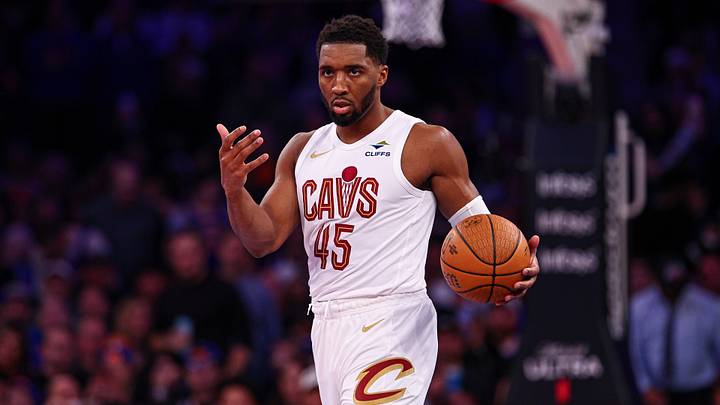
There's something unsettling about the fact that Kenny Atkinson believes the Cleveland Cavaliers' spirit is "better than ever" and Donovan Mitchell believes the team is trending in the right direction. Individually, those sentiments could be interpreted as an attempt to maintain morale during a difficult stretch. Collectively, however, they raise legitimate concerns about the standards being established by the two most influential voices in Cleveland's locker room.
Following Wednesday's loss to the New York Knicks, Mitchell cautioned against becoming discouraged by consecutive defeats, emphasizing that it's still November. He also suggested that Cleveland hadn't necessarily done anything wrong schematically, but rather that the ball simply didn't go in. While maintaining perspective throughout an 82-game season is important, repeatedly rationalizing poor performances can inadvertently cultivate an environment in which mediocrity becomes increasingly tolerable.
Donovan Mitchell risks making complacency acceptable in Cleveland
The problem with Mitchell's assessment isn't necessarily that it's inaccurate, although there's certainly room for debate there. It's that his words carry considerably more weight than those of the average player. When the franchise player consistently downplays the severity of the team's shortcomings, he risks establishing a precedent for everyone else in the locker room.
Consider the message that sends to Cleveland's younger players. They're learning what constitutes acceptable execution, how to respond to adversity and what level of accountability is expected of them on a team with championship aspirations. If disappointing performances are routinely attributed to unfavorable shooting variance, what incentive is there to critically examine the decisions that contributed to those outcomes?
There's also a considerable difference between missing a good shot and failing to generate a better one. The former is an unavoidable reality of basketball, while the latter is something players and coaches can actively address. Conflating the two risks absolving players of responsibility for the quality of their possessions, particularly when fatigue sets in and defensive pressure intensifies.
Cleveland's veterans cannot demand accountability they aren't willing to demonstrate
What's particularly interesting about the messaging coming from Mitchell and Atkinson is how it contrasts with the concerns raised by other members of the team. Peyton Watson recently challenged his teammates to examine their individual effort, suggesting that Cleveland's abundance of talent means very little if everyone isn't fully committed to the work required to win.
That's precisely the sort of conversation Mitchell should be encouraging. Instead, his assessment risks undermining the urgency Watson is attempting to establish. Imagine being a relatively new member of this organization, questioning the collective effort of your teammates, only to hear the franchise player suggest that things are moving in the right direction and that the offensive execution wasn't necessarily problematic.
Furthermore, Atkinson has already entertained the possibility of playing too many young players together. It would be particularly concerning if Cleveland's younger players were subjected to greater scrutiny for the team's deficiencies while its established veterans were afforded the luxury of attributing disappointing performances to circumstances beyond their control.
Accountability becomes considerably less effective when it's selectively applied. Mitchell and James Harden should be held to an even higher standard precisely because of their experience, influence and considerable responsibilities within Cleveland's offense.
The Cavaliers can't manufacture championship habits in April
Perhaps the greatest danger associated with Cleveland's apparent complacency is the assumption that competitive discipline is something the team can summon whenever the circumstances require it. Championship habits are developed throughout the regular season, often during relatively inconsequential games when there's very little external motivation to perform at an exceptional level.
Every possession presents an opportunity to reinforce those habits. Communicating through defensive switches, relocating after giving up the basketball, maintaining offensive discipline when shots aren't falling and responding intelligently to an opponent's adjustments are all behaviors that become instinctive through repetition.
However, if the Cavaliers continually attribute their shortcomings to unfortunate circumstances, they risk reinforcing the very behaviors that could ultimately compromise their championship aspirations. The postseason is a particularly unforgiving environment in which to discover that the habits you've spent six months developing aren't conducive to winning at the highest level.
Mitchell doesn't need to publicly disparage his teammates or question Cleveland's championship potential. But part of his responsibility as the franchise player is to ensure that the standard of performance within that locker room remains considerably higher than what anyone is currently producing collectively.
Believing you're capable of winning a championship is wonderful, Donovan. Making everyone around you uncomfortable with anything less than championship-caliber execution would be considerably more beneficial.
 Add us as a preferred source on Google