

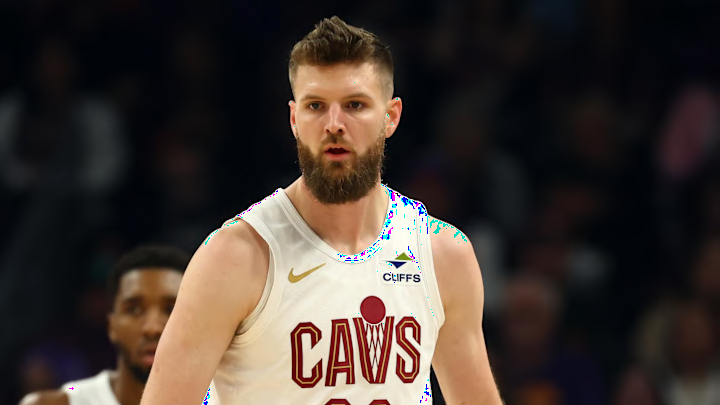
Dean Wade has emerged as one of the Cleveland Cavaliers' most pivotal roleplayers after entering the NBA as an undiscovered G League talent.
In his seventh NBA season, Wade is averaging 5.8 points and 4.1 rebounds per game for the Cavaliers while shooting 34 percent on three-pointers. His counting stats are not jaw-dropping, and his ocassional loss in shooting confidence can hurt the Cavs over a stretch. Still, he has continually proved his undeniable value as a legitimate 3-and-D threat over the course of his Cleveland tenure.
This season, Wade is in Bball-Index's 99th percentile for Defensive Positional Versatility. Standing at 6-foot-9, Wade is capable of guarding frontcourt opponents, but his strength and lateral quickness also make him one of the best perimter defenders. Bball-Index also ranks Wade in the 87th percentile in Perimeter Isolation Defense.
Getting past Wade is no easy feat. While he does not have the All-Defensive accolades to his name, the Cavaliers clearly value Wade's defensive talent. Cleveland's defense allows 3.3 fewer points per 100 possessions with Wade on the court, per Cleaning the Glass (subscription required). Opposing teams also see a 1.6-percent drop in effective field goal percentage with Wade on the court.
There is no doubt in the Cavaliers locker room that Wade is a one-of-a-kind roleplayer. He is a tough, physical defender who chases rebounds and can hit down open catch-and-shoot threes on the other end. Still, Cleveland is facing a Wade-centric crisis as he nears a return from injury.
The Cavaliers have no clear role for Wade
With injuries hampering the Cavs all season so far, Wade has been in and out of the starting five. Wade has been one of the highest-impact players on the roster, appearing in many of the Cavs' most effective five-man lineups.
As the Cavaliers approach the playoffs, however, Wade's role is almost certainly going to leave him as a bench talent behind Jaylon Tyson and Evan Mobley as the starting forwards. Wade's size and positional versatility have often made him an ideal starting small forward, but Tyson's rise to prominence as a foundational piece to the franchise makes him a clear choice over Wade in the starting unit.
Additionally, Cleveland's De'Andre Hunter trade at the deadline brought back two ideal backcourt talents in Dennis Schroder and Keon Ellis, but it left a hole in the depth chart for another big forward who can play behind Mobley. Newly-signed Nae'Qwan Tomlin can fill that spot, but his limited offensive skill set and underdeveloped NBA experience make Wade an obvious fit to play the backup four spot.
The best version of Dean Wade the Cavaliers have seen this season has included him as a starter. Wade is a rhythm player, and when he saw more opportunities with the best players, he showed more impact. Taking him away from his best environment for on-court success could disrupt his rhythm, drastically decreasing his odds of continuing his impact.
Right now, Wade is bouncing between starting small forward and backup power forward jobs. Cleveland knows that starting Wade gives a top-level point-of-attack defender and a solid three-point shooter, but Tyson has solidified his spot as a fundamental building block. Once fully healthy, the Cavaliers will also have Max Strus battling for minutes on the wing alongside Sam Merrill.
Cleveland cannot expect to see the best version of Wade when his job is constantly in flux. If they cannot fit him into their offensive system now, it will be hard to maximize him in the postseason.
Cleveland, by all accounts, is suffering from success. This Dean Wade conundrum is the sort of issue 29 other coaching staffs would love to have to solve. The Cavs have discovered numerous overlooked talents through the G League, Wade likely being the best story. Others like Sam Merrill had already seen the NBA stage before entering Cleveland's system, but Wade was an undrafted rookie when he first joined the Cleveland Charge.
Cleveland could lose Wade this summer
With Wade nearing unrestricted free agency this summer, if the Cavaliers cannot secure a definitive, consistent role for the two-way wing, they may face a struggle this offseason to keep him. Last year, reports confirmed the Houston Rockets offered a trade package for Wade with intentions of signing him to a contract worth a full Mid-Level Exception. Currently, Wade is owed roughly $6.5 million this season.
The Cavs hold his Bird Rights and can exceed the luxury tax to retain him, but the Cavaliers already showed a desire to duck unnecessary apron spending at the deadline.
Time is ticking for Cleveland to figure out what to do with Wade. Over his seven seasons, he has continually fallen in and out of the rotation, whether as a bench player or starter. Even with the rise of Tomlin, the Cavaliers do not have an obvious replacement if Wade leaves in free agency. Wade his a rare breed of NBA player, one of the most highly-coveted. He is a bonafide, elite defender with high-value offensive talent. He may not be the most efficient or consistent three-point shooter, but he is a threat from anywhere on the arc and is a tough offensive rebounder.
Cleveland will definitely face heated challenges in free agency to keep Wade. Finding a reliable role to maximize his value on the team should be a top priority for the rest of the season, otherwise the Cavaliers will struggle to analyze his monetary value this summer. Sending a low-ball offer to one of the top roleplayers in free agency this offseason could cost the Cavs more than the luxury tax bill would have cost to keep him.
If the Cleveland Cavaliers want to win an NBA Finals, players like Dean Wade who do a little bit of everything extremely well will be the difference makers. With a top-heavy salary sheet, the Cavs cannot accept losing a player like Wade because they never found the right rotational role for him.
 Add us as a preferred source on Google