

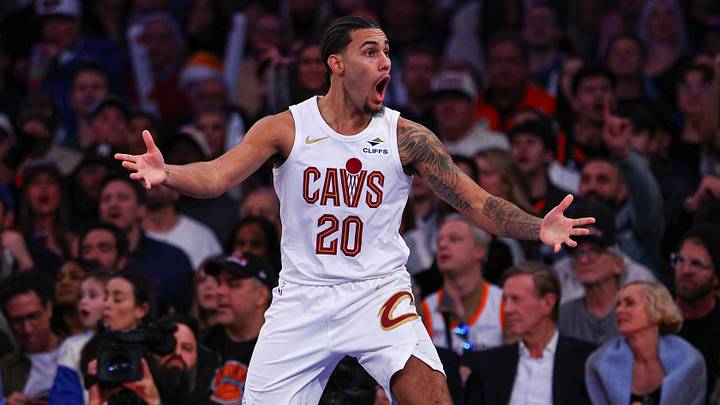
You know what's more frustrating than watching the Cleveland Cavaliers get eliminated from the Emirates NBA Cup? Knowing that we're approaching December and have very little evidence that this basketball team has learned anything from its experiences over the past month.
Detroit's 113-98 victory over Milwaukee on Friday officially eliminated Cleveland from tournament contention. Am I devastated that the Cavaliers won't be competing for the NBA Cup? Not necessarily. What bothers me is that Cleveland had an opportunity to demonstrate some competitive maturity in a condensed tournament format and managed to exhibit virtually every undesirable characteristic we've been complaining about since October.
At what point are we supposed to start seeing the benefits of the adversity this team keeps encountering? Because, goodness, the Cavaliers have accumulated enough learning experiences to start actually showing the fruits of their labor, no?
The Cavaliers are wasting the educational value of the regular season
There's a degree of tolerance afforded to championship contenders during the opening months of the season because we understand that development is a process. Coaches experiment with rotations, players become more familiar with one another, and teams discover which aspects of their identity need some refinement.
However, implicit in that understanding is the expectation that the basketball team will eventually become better at navigating the circumstances that previously gave it trouble. Otherwise, what exactly are we accomplishing with these 82 games?
Cleveland entered the fourth quarter against the New York Knicks on Wednesday with a three-point advantage and a legitimate opportunity to advance in the NBA Cup. The Cavaliers proceeded to lose the period by 22 points, effectively undoing much of what they'd accomplished throughout the competition.
The disturbing part is that Kenny Atkinson's excuses were wearing thin for these very same deficiencies back in October. An entire month later, Cleveland's inability to manage possessions, respond to shifting momentum and maintain its defensive discipline has cost the team an opportunity to compete for a trophy.
That's a developmental failure. I'm far less concerned about Cleveland encountering adversity than I am about its inability to develop immunity to some of the problems it encounters repeatedly. Opposing teams shouldn't be able to exploit the same vulnerabilities for weeks without the Cavaliers making that endeavor a little more difficult.
Cleveland is giving its opponents an education instead
One of the unintended consequences of Cleveland's lack of progress is that its opponents are accumulating useful information about how to beat this basketball team under pressure.
Every time the Cavaliers become offensively predictable, abandon productive actions or struggle to contain an opponent's momentum, they're giving prospective postseason opponents another opportunity to identify tendencies worth exploiting.
Imagine being an opposing coach preparing for a seven-game series against Cleveland. How confident would you feel about your team's chances of recovering from a double-digit deficit? How comfortable would you be instructing your players to increase their defensive aggression late in games, knowing that Cleveland has demonstrated difficulty maintaining its offensive composure?
The Cavaliers should be spending the regular season making themselves a more complicated postseason opponent. Instead, they risk developing a reputation as a talented basketball team whose effectiveness can be compromised by applying enough sustained pressure.
And frankly, I'm getting a little tired of hearing about how talented this roster is. Nobody disputes that. The conversation needs to graduate from what Cleveland is capable of accomplishing to what it's capable of accomplishing reliably.
The Cavaliers have time to improve, but they need to give us something
Fortunately, Cleveland doesn't need to become a finished product tomorrow. Evan Mobley's eventual return should give Atkinson additional tactical flexibility, the younger players have room to grow, and there's enough offensive intelligence on this roster to develop solutions to some of its recurring problems.
But progress doesn't have to announce itself through a lengthy winning streak. I'd happily welcome a competitive loss in which Cleveland demonstrates an improved ability to respond to defensive adjustments, execute under pressure and maintain its offensive structure when shots aren't falling. At least we'd have something tangible to build upon.
That's what makes the NBA Cup elimination so aggravating. It provided the Cavaliers with an opportunity to measure their development in an environment where individual possessions carried additional consequences, and the results weren't encouraging.
By the time the postseason arrives, Cleveland should be able to draw upon months of accumulated experience to navigate difficult situations. That experience becomes a lot less valuable if the team spends those months making the same mistakes without developing dependable solutions.
I'm not ready to abandon Cleveland's championship aspirations, nor do I think anybody needs to at this juncture. But the Cavaliers have had ample opportunity to establish what doesn't work. It would be lovely if December brought some evidence that they're figuring out what does.
 Add us as a preferred source on Google