

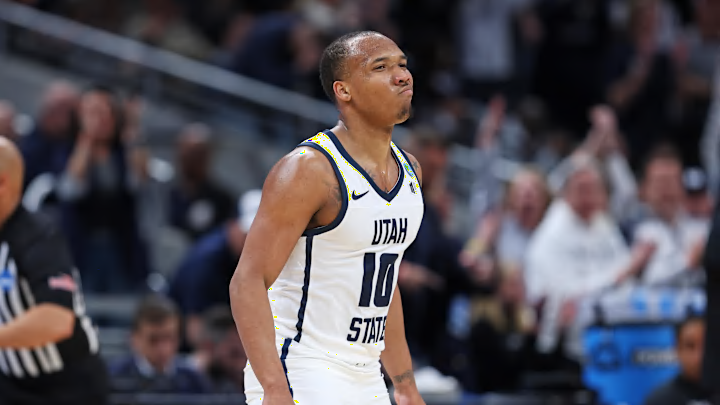
On Feb. 20, the Cleveland Cavaliers made an interesting move, switching up their depth pieces by signing guard Darius Brown II to a two-way contract. To do this, the Cavaliers waived wing Emanuel Miller, who had been a part of the Cavaliers since he was acquired in the De'Andre Hunter deal on Feb. 1.
To be completely honest, this deal in all likelihood will have no bearing on Cleveland's championship hopes come June. Even so, Brown is still an interesting piece as a guard off the bench.
With injuries and various other factors in play, it is not otherworldly to suggest that Brown could find a role at some point. Let's take a look at his background.
Darius Brown II has been productive at every stop
Coming out of high school, Brown didn't commit to Duke, Kentucky, Kansas, or any other power conference program. Instead, he arrived for his freshman season at Cal State Northridge, a smaller Big West school, in 2018-19.
From the moment he stepped on campus, though, Brown was a key contributor. Through his first three years in the program, Brown started every game he played in.
In his junior season, he led the Big West in minutes at 34.5 per game, while averaging 10.5 points, 4.8 rebounds, 5.3 assists and 2.0 steals. He also shot 36.8 percent from 3-point on over three attempts per game. Brown then had his senior season at Cal State Northridge cut short with an injury, only appearing in eight games.
With both a medical redshirt and an extra year of eligibility due to COVID-19, Brown transferred to Montana State for his fifth season in 2022-23. At a slightly bigger program, Brown produced a similar output to what he had in the past. He tallied 9.5 points per game, 4.9 assists and a Big Sky-best 1.8 steals per game while starting in 33 contests. Brown also shot a career-best 39.7 percent from deep albeit on just over two attempts per game.
After his lone season at Montana State, Brown took a major step up, skyrocketing his career trajectory with a transfer to Utah State for the 2023-24 season. In his final year of eligibility, Brown improved in virtually every category.
He ended up posting career-bests in points (12.5), assists (6.5) and 3-point percentage (39.8). The shooting was the key skill here, as not only did Brown produce his best percentage from deep, but he more than doubled his attempts per game to 4.6
After finishing a career year where he showed vast improvement while also taking on a career-high in usage (17.9 percent), Brown, who was out of eligibility, entered his name in the 2024 NBA Draft.
However, it is certainly an uphill battle for a 6'2'' guard to make it to the league, and Brown went undrafted. Between, his size and his age, which was almost 25 at the time of the draft, it just didn't make a whole lot of sense for a team to select him.
There was a pitch, though, which led to Brown signing with the Cavaliers' G League affiliate, the Cleveland Charge. The reason Brown got a chance was twofold.
Firstly, he had always shown real playmaking chops, highlighted by his assist numbers, and had some peskiness as a stocky 195 pound point of attack defender. He displayed the tangible aspects of a pure point guard that teams covet. But, most importantly, his growth as an outside shooter in his final season at Utah State is likely what caused the Charge to take a swing on him.
In 2024-25, Brown's first season with the Charge, he was solid. He started in 16 games, averarging 27.1 minutes per contest while averaging 7.7 points and 5.1 assists per game. He didn't shoot the ball very well, though, only 31.3 percent from distance, a discouraging sign that perhaps his leap at Utah State was an outlier.
Despite the questionable first year, Brown returned for year two this season with a vengeance. He leapt his scoring up to 13.1 points, while taking his assist numbers to a whopping 9.9 per game. Not only that, but his shooting percentages jumped back up to 40.7 percent from behind the arc.
After such a breakout campaign, it was fitting that the Cavaliers took a swing on him. A veteran presence who has gotten onto the court at every stop is valuable, especially for a point guard.
Darius Brown II provides insurance to the high-leverage stars
As of now, Brown sits about as far back as one can get on Cleveland's depth chart at point guard. Donovan Mitchell and James Harden obviously comprise the starting guards, but Harden's recent thumb injury could complicate things a tad.
Up next is the newly acquired Dennis Schroder. He seems to have solidified his place as the backup point guard, and could be the biggest beneficiary if Harden misses any time. Craig Porter Jr. is also still on the roster and still sees minutes. Kenny Atkinson has not been afraid to throw Porter Jr. out there frequently before, so he's another who would benefit from a Harden absence.
Harden, Schroder and Porter Jr. are the only other true point guards on the roster. However, Mitchell has been known to assume that role in the past.
Previously, when Darius Garland was on the roster and was injured, Mitchell would frequently play the point along with a pair of wings, Evan Mobley and Jarrett Allen. In fact, the Cavaliers' most frequently used lineup amongst players on the current roster has consisted of Mitchell, Jaylon Tyson, Dean Wade, Mobley and Allen.
All of that is to say that it's going to be a steep uphill battle for Brown to crack the rotation. But hey, crazier things have happened before and for now, Brown will provide a quality depth piece that will help the Cavaliers in reserve.
 Add us as a preferred source on Google