

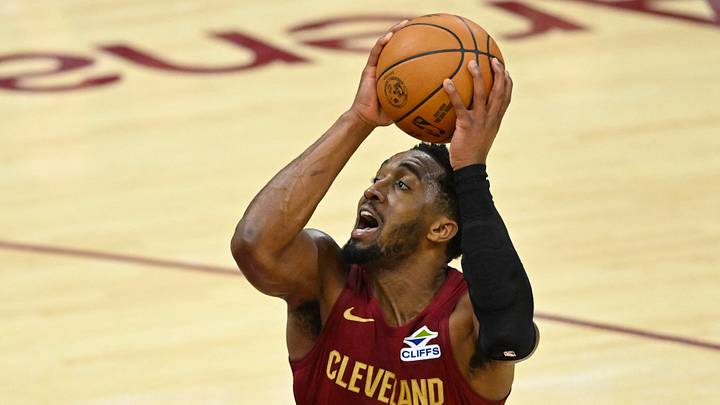
The Cleveland Cavaliers have enough three-point shooters to make opposing defenses miserable. At least, that's how things are supposed to work. Between Donovan Mitchell, James Harden, Meleek Thomas, Tyrese Proctor and several other perimeter threats, Cleveland has assembled a roster that should make finding open space considerably easier.
Instead, the Cavaliers still have possessions where the floor looks unnecessarily crowded, the ball spends too much time in one player's hands and everyone else appears to be waiting for something interesting to happen.
It's a strange predicament for a team averaging more than 41 three-point attempts per game, the sixth-highest total in the NBA. Cleveland certainly isn't shy about shooting from the perimeter. The bigger question is whether its offense consistently creates the kind of space that makes those attempts worthwhile.
Because there's a difference between having shooters on the floor and actually using them to stretch a defense.
Cleveland's shooting numbers don't tell the entire story
The Cavaliers rank among the league's better offensive teams, and their three-point volume is a major reason why. They're attempting approximately 41.2 threes per game while maintaining an effective field-goal percentage of 56 percent, one of the NBA's strongest marks.
Those numbers make it difficult to argue that Cleveland's offense is fundamentally ineffective. However, they don't mean its spacing is beyond criticism.
Consider how the Cavaliers distribute their possessions. Approximately 64.2 percent of their made field goals are assisted, placing them 22nd in the league in assist rate. That doesn't automatically indicate poor ball movement, particularly for a team featuring accomplished individual creators like Mitchell and Harden.
It does, however, highlight how much Cleveland relies on players generating offense through their own decisions rather than a consistently flowing system.
When those individual creators are successful, the Cavaliers can score in bunches. When the defense cuts off the initial action, possessions can become considerably less comfortable.
The Cavaliers need movement, not just shooting ability
Spacing is often discussed as though it's simply a matter of putting several respectable three-point shooters on the court. In reality, it's also about positioning, timing, cutting and forcing defenders to make difficult choices.
A stationary shooter might command attention, but a shooter who relocates at the right moment can completely disrupt a defensive rotation. Likewise, a well-timed cut can create an opening that standing behind the arc never would.
Cleveland's numbers offer an interesting contrast. The Cavaliers are highly effective on spot-up possessions, generating approximately 1.12 points per possession. However, their off-screen possessions produce only about 0.70 points apiece, ranking near the bottom of the league.
Those are different play types, so the figures shouldn't be treated as a direct measurement of spacing. Still, they suggest Cleveland is considerably more comfortable finishing possessions from established positions than creating offense through certain forms of off-ball movement. That's an area where Atkinson should be demanding more.
The issue becomes especially relevant when Evan Mobley and Jarrett Allen share the floor. Both provide important interior contributions, but neither creates the same perimeter gravity as a traditional stretch big.
Cleveland has already faced questions about whether its frontcourt construction limits spacing, and those concerns become more significant when the perimeter players aren't consistently moving to create new openings.
Kenny Atkinson has to make the pieces work together
The Cavaliers don't need another collection of shooters to solve this problem. They need a more deliberate approach to maximizing the ones they already have.
Thomas and Proctor have provided encouraging shooting production, giving Cleveland additional options beyond its established stars. Watson has also shown that he can contribute through aggressive cuts and attacks rather than relying exclusively on perimeter attempts.
Those skills should complement one another, but that requires an offense built around more than waiting for Mitchell or Harden to draw an extra defender.
Atkinson has to ensure that Cleveland's shooters are moving with purpose, its big men are being used to create openings and its offensive actions don't become predictable when the initial opportunity disappears. There's no reason a roster with this much talent should have to work harder than necessary to manufacture quality looks.
The Cavaliers are already good at making shots. That's not really in dispute. What remains questionable is whether they're consistently creating the best possible shots for the players taking them.
Cleveland has invested heavily in offensive talent. Now it needs an offense that makes all that talent fit together, rather than simply hoping someone gets hot enough to make the spacing problems disappear.
 Add us as a preferred source on Google