

At this point in the 2025-26 season, the Cleveland Cavaliers have a lot of holes that will need to get fixed in some form or another. High on that list will be perimeter defense, particularly at the point of attack.
The flaw can largely be chalked up to roster construction, as a team centered around Darius Garland and Donovan Mitchell as the lead guards has put the Cavaliers at an already defensive disadvantage. Between their size and offensive role, neither is a viable option to shut down an opponent's top guard.
Past Garland and Mitchell, the amount of solid guard defenders is alarmingly low and has been for years. Max Strus, who might be the best of the bunch, hasn't played yet this season and despite taking many of the tougher assignments in the past, he still isn't perfect of the defensive end.
De'Andre Hunter and Jaylon Tyson are both better suited on bigger wings rather than quicker guards and Sam Merrill just doesn't have the mobility to stay in front of said quick guards. That leaves Lonzo Ball, Tyrese Proctor, and Craig Porter Jr., who all play in part for their defensive repertoire.
However, all three have major warts in their games. In his first season in Cleveland, Ball has been, quite frankly, not good at all. He's a solid defender, but his offensive numbers have been so putrid that it's been hard for Kenny Atkinson to justify keeping on the floor at all.
It's a similar story for Proctor, as his development in his rookie season has taken longer than many have hoped. Porter has yielded more positive returns than the other two and his peskiness guarding point guards has value, but he's so small that he doesn't much defensive versatility that teams covet.
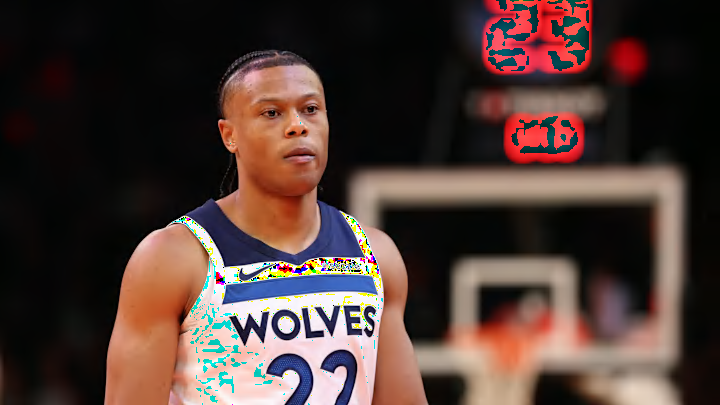
Jaylen Clark can give Cleveland the defensive boost they desperately need
Considering the Cavaliers' rigid cap situation, they don't have much room to operate, but a deal for Jaylen Clark of the Minnesota Timberwolves would solve a lot of their problems while not adding a large salary to the fold.
The Timberwolves are contenders. That should make them hesitant to trade a key piece, in theory. However, their financial situation is similar to Cleveland's in that it would be in their best interest to get cheaper in any way they could.
Clark, while only making a bit over $2 million this season, is set to hit restricted free agency this summer and will likely get offered more than Minnesota can match. So, it would behoove them to move Clark and get at least something in return.
Clark's profile is an interesting one. He missed his entire rookie season after an Achilles tear. In 2024-25, he appeared in 40 games and was somewhat productive. He shot 43 percent from 3-point in limited attempts.
That was extremely promising, given the question marks about his shot coming out of UCLA. However, he's come back to Earth this season with his 3-point percentage dropping to 30 percent.
Offensively, Clark's on-ball ability is quite possibly as low as anyone in the league's. His usage is just barely above Rudy Gobert's and he just doesn't have much juice or gravity with the ball in his hands. That is a major reason for the fact that he hasn't averaged more than 14 minutes per game in his two seasons.
He also has both an extremely low assist and turnover rate just because he isn't tasked to do much offensively. The hope is that he can make spot up 3s (which he hasn't this year) and attack closeouts. He actually has been effective in the latter, as his free throw rate is surprisingly high, even eclipsing Anthony Edwards.
Clearly, the defensive side is the best part of Clark's profile. He is extremely active with his hands and is tied for first on the Timberwolves in steal rate amongst those who have played over 15 games this season, and slides his feel well. His defensive box plus/minus is also the highest on the team with the same game restrictions and he offers the versatility to guard one to three.
Clark would fit perfectly within the Cavaliers' roster construction
To acquire Clark, the Cavaliers would have to part with some draft capital — a first round pick being unlikely but certainly possible. They would likely also have to deal a player too, depending on how badly they would want Clark and how unwilling Minnesota may be to give him up.
If Cleveland does trade a player, Ball would likely make the most sense for both sides. For the Cavaliers, they shed a chunk of his salary and replace him with someone more suited towards their needs. For the Timberwolves, they acquire an offensive initiator (which they sorely lack) and have the ability to not pick up Ball's club option after this season if it doesn't work out.
Let's assume that the bulk of the deal is just a Clark-Ball swap. With the assumed starting lineup of Garland, Mitchell, Strus, Evan Mobley and Jarrett Allen, the primary depth off the bench come playoff time would include Tyson, Hunter, Clark, Merrill, Dean Wade and perhaps Porter or Proctor. That gives Cleveland a significant amount of versatility in their lineup construction, particularly on the wing.
A lot of it would be matchup dependent, again, with Clark more utilized to guard smaller players and Hunter or Tyson for larger wings. For example, in a potential Detroit series, Clark could be the matchup for Cade Cunningham and or even a player such as Tyrese Maxey in a Philadelphia series.
It's also important to note than Strus is still out with a foot injury. With his status continuously in question, wing depth is crucial.
The problem with flipping Ball for Clark is that Cleveland would then lose a ball handler. If Porter Jr. was fully ready for a more consistent role than it wouldn't be an issue but that probably isn't the case. So, at least one of Garland or Mitchell will need to be on the floor almost at all times and if not, Mobley might take on a more initiator-like role, which he struggled with early on this year.
Regardless, a deal for Clark would solve a persisting issue within the Cavaliers' makeup. At least for the rest of this year, it may give them some answers.
 Add us as a preferred source on Google