

Trades in the National Basketball Association are rarely simple.
On the surface, trades are about trading players for other players, but that is only the beginning. Draft picks are involved and have rules on how and when they can be traded. Player salaries are a major part, both matching salaries to make trades legal and not pushing a team over this line or that apron. Speaking of aprons, they impose rules on which trades can happen and which cannot. Trade exceptions and hard caps and Stepien rules abound.
The one component of trades that NBA fans may feel is the most mysterious is trading cash. When a team throws in money, what is truly happening? Are there rules governing how and when teams can include money, and how much? That answer is yes; let's dig into those details in the latest edition of our series "Salary Cap 101".
Salary Cap 101: The Rules about Trading Cash
Each NBA team has a defined pool of assets that it can include in a trade, per the rules of the Collective Bargaining Agreement (CBA). They can trade players under contract, of course, as well as the draft rights to a prospect who has not come to the NBA. They can trade draft picks and the right to swap picks.
Finally, a team can trade pure cash -- but only up to a certain extent. If a team could trade unlimited amounts of cash, Steve Ballmer and other wealthy owners would have a significant advantage over smaller markets and less-wealthy owners.
That limit, as defined in the CBA, is 5.15% of the salary cap. With the cap set at $164.9 million for the 2026-27 season, the most a team can send or receive is $8.49 million during that league year.
The Cavaliers, for example, can send out up to that $8.49 million mark throughout the course of the year, and they can also receive up to $8.49 million. Those two ledgers are accounted separately, so sending out doesn't impact what can be taken in, and vice versa.
How does trading cash make trades legal?
Trading cash in a trade can also help to make trades legal. When a team trades with another team, they cannot merely send out; they must also receive something back. Nothing is truly free in the NBA.
Cash can satisfy that requirement of an asset coming back to a team, if it is at least $110,000 in a two-team trade.
Things get trickier in a trade with three or more teams; the CBA requires each team in such a deal to "touch" at least two other teams. Cash works for this (in addition to players, draft picks and draft rights), but it must be at least $1.1 million.
What if a team trades cash in the future?
NBA trades often contain conditional clauses; if a protected first-round pick doesn't convey, for example, it will become two second-round picks. Cash can work the same way in a deal.
If cash is tied to any future conditional clauses in a trade -- for example, if a team trades a second-round pick, they could say that if it falls after pick No. 50, the receiving team also gets $2 million in cash -- that cash is still accounted for in the league year the trade was consummated, not when the cash is actually exchanged.
Therefore, in the above example, if the teams agreed to the deal in 2026-27, but the cash was tied to the exact location of a 2029 pick, the sending team would calculate that $2 million from their 2026-27 cash limit.
What else counts as cash in a trade?
Tossed around when NBA trades go down are discussions of signing bonuses, performance bonuses, and trade kickers.
Sending teams are allowed to pay part or all of these bonuses as an incentive in the deal; if they do so, however, it counts as "Cash-in-Trade" and is taken from their limit for the year.
How have the Cavaliers used cash in recent trades?
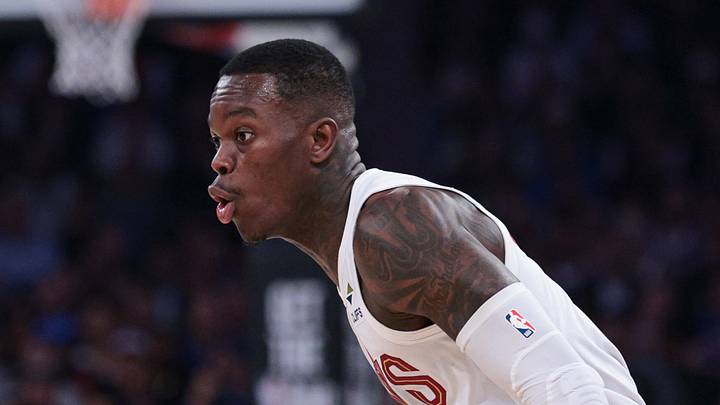
In the 2026 offseason, the Cleveland Cavaliers used cash to move off of the contract of Dennis Schroder. To incentivize the Charlotte Hornets to take on his salary, the Cavaliers sent $4 million along with him, paying for most of the difference in his salary and Tre Mann's, the player who was coming back.
Before that, you have to go back all the way to August of 2021, when the Cavaliers traded cash alongside Taurean Prince and a 2nd-round pick for Ricky Rubio.
Some teams include cash frequently in deals, but the Cavaliers are more conservative.
 Add us as a preferred source on Google