

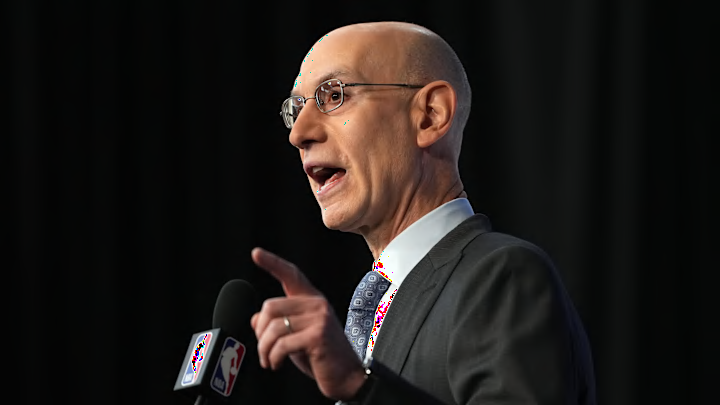
The Cleveland Cavaliers might not be in the NBA lottery this year, but the league's newly-proposed convoluted laws could have killed Cleveland's modern era before it ever started.
In an attempt to curb what the Association believes to be a major problem, tanking, new lottery rules will be potentially implemented immediately. The 2026 NBA Draft might be entirely different than owners, coaches and scouts expected it to be. These changes would add two new teams into the lottery mix and seemingly punish teams for losing too much.
The "3-2-1 lottery" proposal, named to represent the number of lottery balls per team, would expand the lottery from 14 to 16 teams. Teams that do not qualify for the playoffs or play-in tournament but stay out of the relegation zone (spots four through 10) would receive three… https://t.co/sIPAfYE5cL
— Shams Charania (@ShamsCharania) April 28, 2026
NBA insider Shams Charania attempted to break down the new proposed rules in a digestible format. Called the '3-2-1 lottery" proposal, the league will distribute either one, two, or three ping pong balls to each team in the lottery based on their standing. The bottom three teams - title the relegation zone - will receive two lottery balls. Teams from spots 4 through 10 receive three. Play-In teams receive lottery balls as well, even if they advance into the Playoffs. Those who advance in the tournament only receive one lottery ball.
Where you place in the end-of-season standings also determines how far you can possibly fall in the lottery. The bottom three teams can fall as far as pick 12, and the rest of the lottery teams can fall down to the final 16th pick.
Is it feeling overly complicated yet? Yeah, we get it.
The most interesting, and possibly most consequential for some teams, is the rule that no team will be able to receive the top pick in consecutive drafts or a top-five pick in three consecutive drafts.
Reception to these proposed changes has been mixed, but it has already spawned plenty of discussion surrounding how that final rule would have impacted many current rosters. The San Antonio Spurs' three young upcoming stars of Victor Wembanyama (first overall, 2023), Stephon Castle (fourth overall, 2024) and Dylan Harper (second overall, 2025) would not have been able to combine forces without trades.
The Cavaliers would not exist as we know them today
Looking a bit farther back, if these rules had been in place throughout the last decade, the Cavs' own core would have never existed. Darius Garland, Evan Mobley and Isaac Okoro were all selected in the top five in three consecutive drafts. Collin Sexton just barely misses the cut for this rule, drafted eighth in 2018.
While only Mobley remains in wine and gold out of this group, Garland's third-year breakout was the igniting fuel to bring about the Donovan Mitchell era in Cleveland. If the league had manufactured the draft to prevent the Cavs from drafting one or more of Garland, Mobley and Okoro, Cleveland would have never positioned themselves for a Mitchell trade or to return to contender status.
The Cavaliers were not intentionally tanking. LeBron James left in free agency in 2018, and the Kyrie Irving trade from a year prior left the Cavs with no star power other than Kevin Love to keep them in the Playoff race. Having a bad record and getting lucky in the lottery was the only mechanism the Cavaliers had to return to any semblance of competitiveness.
It takes a lot of talent to succeed in the NBA. In Garland's first All-Star season, the Cavs earned a spot in the Play-In Tournament but failed to reach the Playoffs due to inexperience and poor roster construction. Cleveland was not ready to compete for the postseason yet and entered the lottery once again.
These new proposals would not have forced the Cavaliers to stop being bad. They would have prolonged the suffering of the team and the fan base. If a teams already on the cusp of the Playoffs had swapped places with Cleveland in 2021 because of these rules, Mobley would never have joined the Cavs' ranks. The team would likely still be struggling to contend for a title like the league would have wanted.
Cleveland would have been punished for trying to build a contender the exact way the league wants. Fans would have been left wondering how a small market team would ever rise back to prominence if the lottery was intentionally designed not to allow them the best chances at great players.
The NBA's proposal is misguided
The league's new potential changes are meant to target intentional, out-of-hand tanking. Franchises like the Utah Jazz spent the latter half of the regular season sitting players in the final quarter in order to lose. The Washington Wizards did not play either of their trade-deadline acquisitions Trae Young and Anthony Davis in an effort to manipulate their lottery luck.
If the NBA institutes these changes before the 2026 Draft, those franchises who overtly intentionally lost for the sake of a better chance at drafting top talent could be sorely disappointed. An end result that includes tanking teams missing out on AJ Dybantsa is exactly what Adam Silver and the league wants, but those consequences extend to organizations genuinely struggling to build a contender.
The Cavaliers are an obvious example for most readers of King James Gospel, but they are far from the only example. The current lottery odds are the reason the Wizards finally accepted an unsavory route to building a contender. Washington has continually fallen in the lottery. The last time they had the top pick was when they selected John Wall in the 2010 Draft.
Washington has reached the Playoffs five times since drafting John Wall. During the Wall era, the Wizards never stopped trying to win, but the franchise has stayed historically bad. Adding new rules to prevent them from tanking spits in the face of the Draft. The NBA is trying to punish a bad team for being bad. There is no logic in that.
Preventing repeated first-overall or top-five picks can be a benefit as it rotates the chances for the best talent. Combining that with complicated, unintelligable jargon and 3-2-1 rules just leaves lottery-bound teams with no direction and minimal hope for their future. Suddenly, being one of the three worst teams in basketball means your team the same chance to get the best draft pick as teams who narrowly missed the Playoffs.
The Cleveland Cavaliers are avoiding this treacherous lottery plague for now, but when the next rebuild button is hit, there will be no clear answer to get back to prominence.
 Add us as a preferred source on Google