

In the immediate aftermath of an embarrassing four-game sweep to the New York Knicks in the Eastern Conference Finals, the Cleveland Cavaliers can look to be on the verge of an all-time implosion.
The Cavs made an all-in move at the trade deadline for James Harden, shipping out Darius Garland to the LA Clippers. Clearly, the Cavaliers were not willing to risk another shaky postseason run as Garland's injury concerns persisted. The All-Star point guard had missed time all season due to a toe injury sustained in the 2025 Playoffs, but Cleveland ran out of time to experiment with an undersized backcourt duo.
Despite the collapse against New York, the Cavaliers saw tangible improvement in the playoffs. For the first time since 2018, the Cavs reached the Eastern Conference Finals. It was also the franchise’s first time winning multiple second-round games since 2018. While the ending could have been sweeter and less bitter, the Cavaliers saw progress.
By most measures, the Cavaliers improved this season; yet that progress came with an 8-10 postseason record. It is the absolute worst record possible for a conference finals run. That speaks both to Cleveland’s resilience in two Game Seven wins and to how difficult the road to the conference finals ultimately became for a team that looked utterly spent.
Cleveland's progress is not enough, and the front office is entering another offseason with expectations of major looming decisions. Cleveland remained the only franchise above the second apron threshold of the luxury tax all season, but remaining there now feels increasingly unlikely. The Cavaliers' avenues to improve are heavily restricted until they drop below the second apron, suggesting trades are inevitable.
According to Spotrac, the Cavs enter the offseason just $210 thousand over the second apron, although that does not include free agents Dean Wade or Keon Ellis. Their slim financial margins will likely be eased if James Harden declines his $42.3 million player option and signs a cheaper multi-year deal. Still, the Cavaliers cannot run back the same crew and expect different results.
Kenny Atkinson’s playoff decisions could cost him his job
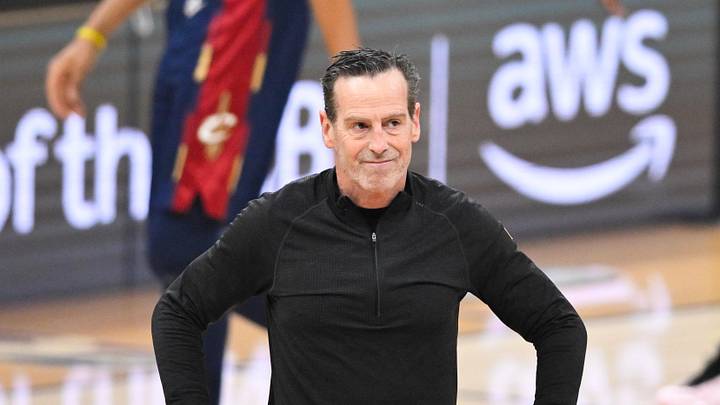
The Cavaliers have been historically patient with coaches. JB Bickerstaff led the coaching staff for just over four seasons before being fired, and Cleveland has had long tenures with numerous coaches throughout their time in the NBA. Kenny Atkinson, however, may have fumbled his way to a short stay with abysmal in-game adjustments and media blunders.
Atkinson's biggest failure was undoubtedly the Cavaliers' 22-point lead being squandered by the Knicks in Game One. With fewer than eight minutes remaining in regulation, the Cavs held a seemingly insurmountable lead, but New York's Jalen Brunson single-handedly tore down the Cavaliers' advantage by picking on James Harden one-on-one. The Knicks went on a 44-11 run in the final minutes of regulation and overtime to steal the win.
Cleveland left Harden on the court the entire time, and Atkinson hesitated to call a timeout and stall the Knicks' run. He made no adjustments and allowed the Cavaliers to collapse in real time, stating in the postgame interview he likes to "save his timeouts." It was a hard-to-watch disaster from a coaching perspective, and it and it gave New York momentum in what quickly became a one-sided series. That moment only stacked on top of Atkinson's questionable four-guard lineups used throughout the season and his insistence on a hyper-analytical approach to the game. His late-game adjustments seemed not to follow the flow of the game, but what his spreadsheets expected to see.
While Atkinson ignited the Cavaliers to a historic 64-win season in his first year, he was repeatedly out-coached by New York's Mike Brown. Atkinson might deserve another shot at the helm, but Cleveland cannot afford the embarrassment and need new leadership. Analytical wins aside, Atkinson needs to go.
Dean Wade's offensive shortcomings are glaring
Cleveland's starting small forward throughout the playoffs, Dean Wade, may also be the team's worst offensive player. He is a defensive stalwart, standing at 6-foot-9 and being capable of guarding every position. Unfortunately, the Cavaliers could not rely on Wade on offense enough to serve as a relief for the stars.
While Wade shot 38.3 percent from deep in the postseason, he did so on just 2.8 attempts per game, and his overall offensive impact was far too unreliable. If young wing Jaylon Tyson takes another step forward, he and Max Strus both offer more balance and energy on both ends of the court.
This summer, Wade is an unrestricted free agent and will certainly seek a pay raise from his $6.6 million price tag this season. With the Cavaliers' cap sheet, offering that raise and re-entering the second apron for a limited offensive player is not worth the defensive upside. If Cleveland can duck the apron, the Taxpayer Mid-Level Exception could easily net a better two-way talent, and a smart trade could open up the full MLE.
Keeping Wade is too expensive and has not yielded the results Cleveland needs.
Cavaliers have to trade Dennis Schröder
The Cavaliers hoped they found the right backup point guard at the deadline, adding Dennis Schröder and Keon Ellis for De'Andre Hunter. For the most part, Schröder brought the leadership and intensity the Cavaliers hoped to see. His inconsistent production and high price point put him on the trade block, however.
The 32-year-old guard has the fifth-highest salary in Cleveland at $14.8 million next season. If Cleveland wants to gain financial flexibility without moving star players, dangling Schröder on the trade market is a must.
As a Cavalier, Dennis averaged 8.2 points and 4.3 assists per game in the regular season, falling to 5.5 points and 2.4 assists per game in the playoffs. His defensive energy was a positive for the Cavaliers' bench unit, but his overall production was far below expectations.
If the Cavs can swap Schröder for a budget frontcourt talent to back up Evan Mobley and Jarrett Allen, the front office would be performing malpractice by declining.
Ultimately, the Cavaliers' season was a success — but just barely. Cleveland entered the season with eyes on the NBA Finals, but reaching the conference finals was the bare minimum. Winning Game Seven against the Detroit Pistons brought that years-long dream into reality. Donovan Mitchell reached his first conference finals of his career, and the Cavaliers were finally one of the final teams left in the playoffs. With such an expensive roster, however, losing every game of the ECF taints that achievement.
Reaching the long-awaited conference finals is a welcome sign of progress, but the same flaws that had cost the Cavaliers in earlier rounds were still present. Cleveland showed a willingness to make blockbuster moves to chase the Finals, and this playoff run proved that improving the roster’s depth may be the final step forward. Cleveland's financial constraints will force significant changes to keep moving forward.
 Add us as a preferred source on Google