

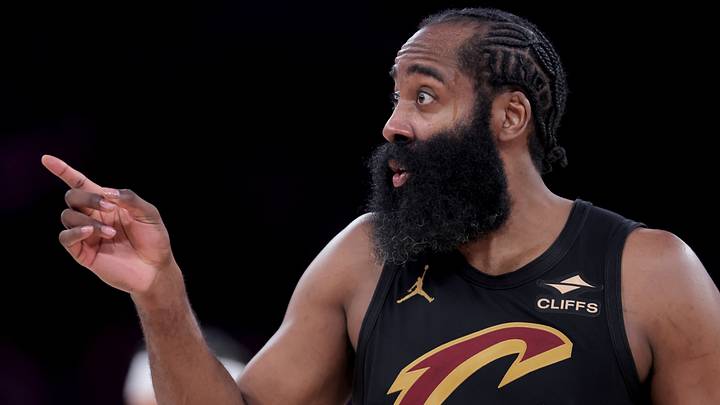
There was a James Harden sighting at Madison Square Garden on Wednesday night, and you know what? It was a sight to behold.
Harden apparently found a way to summon the last vestiges of his superpowers, treating Cleveland Cavaliers fans to a vintage performance straight out of his Houston Rockets days. There were stepbacks, contested pull-up threes, clutch buckets and enough offensive wizardry to make us forget, momentarily, that Father Time is in hot pursuit.
Harden finished with 32 points, shooting 9-of-14 from the field and 5-of-7 from beyond the arc as Cleveland defeated the New York Knicks 115-107, snapping New York's four-game winning streak.
He deserves the lion's share of the credit for ending Cleveland's five-game losing streak against the Knicks. However, what if this spectacular performance turns out to be a bad thing for the Cavaliers? Sometimes, the most dangerous outcomes are the ones that initially look like blessings.
James Harden's throwback performance could reinforce the wrong habits
There's no denying that Harden was magnificent. He looked comfortable creating his own offense, attacked defenders with confidence and delivered when Cleveland desperately needed someone to take control. The problem isn't what Harden accomplished Wednesday. It's what a performance like this could encourage him to attempt Friday, Sunday and every game thereafter.
Before facing New York, Harden was averaging 15.3 points per game while shooting 36.4 percent from the field. Those numbers weren't exactly screaming for more offensive responsibility. One spectacular night doesn't erase the evidence that his efficiency has declined.
At 37, Harden can still reach into the closet, dust off the superhero cape and rescue Cleveland from certain defeat. What he can no longer do is put on the cape every night and expect the same results.
That's the difference between an aging superstar who is sometimes capable of greatness and one who can consistently deliver it. The danger comes when Harden starts confusing the occasional flash of brilliance with proof that his old offensive approach remains sustainable.
When asked why his PPG were down, James himself said that he used to score a lot of points and still can, but he looks for other ways to impact the game. The only problem with that is that it seems like slight denial. His efficiency is down because of the number of shots he's taking and missing.
If he was just taking a lower number of shots in general and was being efficient, maybe that explanation would carry some weight. Instead, it seems more like his conditioning is not where it should be, and he's a step slower because of it. That aside, he doesn't and shouldn't need many shots per game to have an impact, if what he claims is true.
Evan Mobley's development cannot become collateral damage
Perhaps the most concerning number from Wednesday's victory wasn't Harden's 32 points. It was Evan Mobley's eight field-goal attempts. Mobley finished with 10 points and five rebounds in more than 32 minutes. For a young Defensive Player of the Year expected to become Cleveland's next offensive cornerstone, that's an alarmingly modest workload.
Meanwhile, Harden attempted 14 shots and earned another 11 free-throw attempts. Those trips to the line aren't reflected in his field-goal total, but they demonstrate how frequently Cleveland's possessions revolved around him.
For context, Mobley has been averaging roughly 12 field-goal attempts per game. We've already argued that Cleveland should be pushing him toward 16, allowing him to develop the offensive assertiveness required of a legitimate second option. Wednesday represented movement in the opposite direction.
The Cavaliers didn't acquire Harden to prevent Mobley from reaching his ceiling. They acquired him to help win a championship, and that objective becomes much more realistic if Mobley develops into a dependable 20-point scorer. Harden's occasional scoring explosions shouldn't interfere with that process.
Cleveland must resist the temptation to chase Harden's past
There's an uncomfortable possibility that Wednesday's victory provided exactly the wrong kind of encouragement. A struggling veteran superstar rediscovered his old magic, delivered a desperately needed victory and reminded everyone why he once terrified opposing defenses. That's wonderful for one night.
It's considerably less wonderful if Cleveland interprets the performance as justification for giving Harden the keys to an offense that should increasingly feature Mitchell and Mobley. Nobody is suggesting Harden should deliberately fail. The Cavaliers needed that victory, and he earned every bit of the praise coming his way.
The concern is what happens when his superpowers abandon him. Cleveland needs Harden to embrace the player he is today, not spend the season trying to resurrect the player he used to be. Because James Harden can turn back the clock to win a game, only for the Cavaliers to lose their future by refusing to move forward.
 Add us as a preferred source on Google