

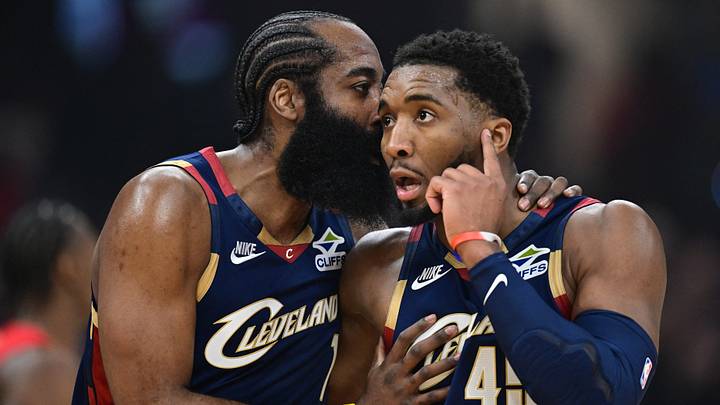
The Cleveland Cavaliers have spent years searching for the right combination of talent around Donovan Mitchell. Now they have James Harden, a former MVP whose offensive résumé could double as a basketball instruction manual.
That pairing has everything necessary to enter the NBA's best-backcourt conversation. Mitchell is an explosive scorer who can overwhelm defenders from virtually anywhere on the floor. Harden remains one of the league's most accomplished playmakers, capable of manipulating defensive coverages until someone gets an easy basket.
Their individual credentials aren't the issue. The question is whether Cleveland can turn two outstanding offensive players into a partnership that makes both more dangerous.
Harden's playmaking could be the difference between good and elite
The Cavaliers don't need Harden to compete with Mitchell for the scoring title. His greatest contribution might come from making everyone else's job easier. Harden's ability to read help defenders and deliver passes into tight windows gives Cleveland another way to attack. Evan Mobley and Jarrett Allen can benefit from his pick-and-roll command, while the team's perimeter shooters should receive opportunities created by defensive attention elsewhere.
Atkinson has already experimented with pairing Harden more frequently with Mobley and Mitchell with Allen. That approach could help Cleveland maintain a dangerous offensive structure even when its two star guards aren't sharing the floor.
It's a fascinating possibility because the best backcourt isn't necessarily the one producing the most combined points. It's the one consistently creating advantages that opponents struggle to erase.
Mitchell and Harden have the tools to do exactly that.
The competition isn't exactly waiting around. Stephen Curry and Jimmy Butler give Golden State a combination of shooting and physicality, while Luka Doncic and Austin Reaves present their own offensive headaches in Los Angeles. Mitchell and Harden have a legitimate argument against either pairing, particularly when it comes to balancing explosive scoring with elite playmaking.
What separates Cleveland's duo is the potential for both guards to control an offense without needing the same possessions to be effective. Mitchell can take over as a scorer, while Harden can dictate the action as a facilitator. That's a luxury few backcourts can match, although proving it against elite competition is another matter entirely.
The best-backcourt debate comes with a caveat
There's a reason Cleveland can't simply declare victory in October. Basketball has two ends, and opposing teams won't forget that when the postseason arrives.
Mitchell and Harden will face difficult defensive assignments against some of the Eastern Conference's most talented guards. Opponents will test their ability to navigate screens, contain penetration and stay engaged through multiple actions.
Cleveland's acquisition of Peyton Watson should help address those concerns. His defensive versatility gives the Cavaliers another option against dangerous perimeter scorers, potentially allowing their star guards to conserve energy for offense. Of course, Watson can't handle every assignment by himself. The Cavaliers need Mitchell and Harden to provide consistent defensive effort, particularly when opponents deliberately involve them in actions.
Their offensive ceiling might be championship-worthy. Their defensive commitment will help determine whether that ceiling is reachable.
 Add us as a preferred source on Google