

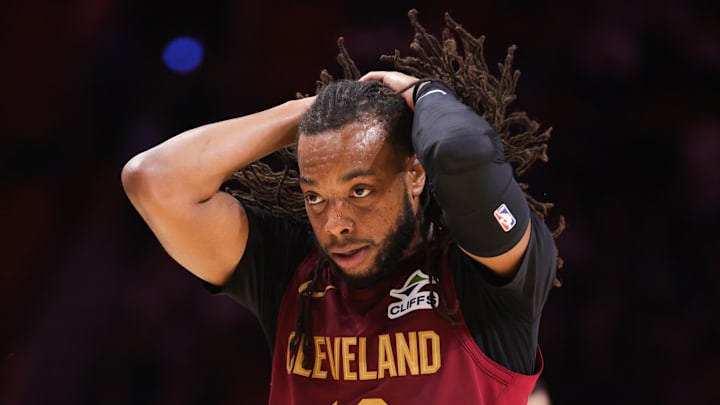
When the Cleveland Cavaliers drafted Darius Garland fifth overall in the 2019 NBA Draft, it was with the hope and expectation that he would lead them to the metaphorical top of mountain at point guard.
Just one year earlier, the Atlanta Hawks made a similar selection with a similar vision as they selected Trae Young at fifth overall. To call either of them a 'bust' as NBA talents would just be incorrect, but clearly, at this point, neither of them have taken their respective organizations to the heights that they had once hoped for.
Finally, over seven years in the making, the Hawks finally pulled the plug on the Young decision, trading him to the Washington Wizards in exchange for CJ McCollum and Corey Kispert. It wound up as a measly package compared to if they had traded him sooner.
In Cleveland, amidst a rocky start Koby Altman and rest of the staff must be looking at Garland with serious worries forming. If they continue to struggle as they have thus far this season and don't trade him, they may find themselves in a similar position to Atlanta.
The last thing the Cavaliers need is to hold onto a talent like that for so long that he loses his value. Therefore, at this point in time, it may be in Cleveland's best interest to capitalize on his value and put itself in a position where it can continue to compete while also stacking assets for the future.
Darius Garland's playing style and role is comparable to Trae Young
It should be stated that measuring the play styles of Garland and Young are not a one-to-one comparison, but their role within their respective teams' roster construction yields similar outputs. To put it plainly, they are both undersized guards with elite shooting and playmaking talent, plus immense defensive liabilities that significantly hinder team performance on that end of the floor.
Let's start with the offense. Young's calling card entering the NBA was his on-ball shooting ability. Life got hard with so much attention on him, but that has held true.
Across his eight-year career, he's averaged 25.2 points per game on 35.1 percent from 3. His true shooting percentage is also 57.9 percent, indicating that despite his incredibly difficult shot diet, his numbers still support a general level of efficiency.
To go with his shooting prowess, Young's playmaking numbers have become elite as well. He averages a career 9.8 assists per game on his career, including a league high 11.6 last season. Not only that, but he has led the NBA in assist rate three times across his eight years.
Garland doesn't quite have the scoring prominence that Young has, but he has still averaged 18.8 points in seven years, including an impressive 38.8 percent from 3. He also sports a 56.8 true shooting percentage. The playmaking is equally impressive, as Garland has recorded 6.7 assists per game across his career.
For context, Young has not played in an environment with anything even closely resembling the level of creators that Garland has, which is reflected in Young's 31.8 percent usage rate versus Garland's 25.7. This, combined with Young's much higher free throw rate can largely explain Young's better counting stats, as well as Garland's higher shooting percentages.
Defensively, as stated earlier, neither guard is anything to write home about.
Both have had negative defensive box plus-minuses in every year of their career up to this point. Last season (both have dealt with injuries this year), they each ranked dead last on their respective team in that category (among players with over 15 games played).
Injuries and contracts also paint a similar picture for Young and Garland
Injuries have also played a role recently. Young hasn't had massive injury problems at any point in his career. He played in at least 60 games throughout each of his first five years, but in 2023-24, he only played in 54 due to a finger injury. Last season, he played 76 games, but this year he's only played in 10 games with knee and quad injuries.
Garland's had a similar road with injuries to Young, staying generally healthy for most of his career (barring the first couple of years), but has missed a significant amount of time this year with toe injuries. Garland has appeared in just 26 games and is out again for at least the next week or so.
The reason injuries play a factor is because they illuminated a glaring statistic for Young and the Hawks. In games that Young did not appear in, Atlanta has played to a 19-17 record. With Young in the lineup, the Hawks were just 2-8 and gave up over 125 points in each of his final five games.
It's a similar story this year for Cleveland. Without Garland, the Cavaliers went 12-7 and with him they went 13-13. However, Garland's toe injury has clearly been hampering thus far this season and last year Cleveland went 60-15 with him, so a positive regression may come once he gets healthier.
Lastly, contracts played a large role in Young's demise in Atlanta. He is set to make over $46 million this season, but he has a player option for next season which is his last year in the contract.
Young's value in the eyes of other teams decreased significantly largely due to the fact that he holds a significant amount of power within that contract. While Young has said he'd like to stay in Washington long-term, he could theoretically leave this summer which scared a lot of teams away.
Garland is making over $39 million this season and is under contract for two more years. In a way, his situation is reminiscent of Young's a couple of years ago. That means that right now is the time when Garland is both the most profitable for the Cavaliers and the most enviable for other franchises who ideally would like to keep him in the long run.
Additionally, if the Cavaliers can get rid of Garland within the next six months or so, they can firstly open up some much-needed cap space on one of the most expensive teams in the league. Secondly, they can give Donovan Mitchell and Evan Mobley more of an offensive load, which both have seemed up to the task for. Thirdly, they can play lineups with more versatility, especially defensively.
Garland is a brilliant player, make no mistake, but perhaps a change of scenery would be exactly what Cleveland needs.
While it may not seem like it, now is the time for Cleveland to make its decision on Garland. In order to capitalize on his value, the Cavaliers must act now to not fall into the same mistake that Atlanta made with Young.
 Add us as a preferred source on Google