

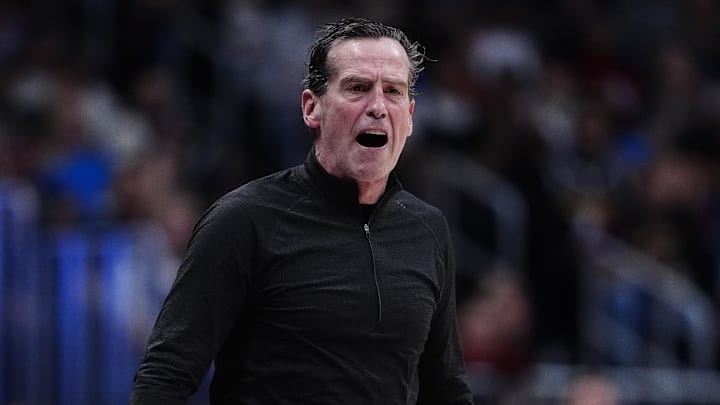
In his second season with the Cleveland Cavaliers, head coach Kenny Atkinson's greatest strength has been ability to find hidden talents across the depth chart and survive lengthy injuries.
Cleveland has faced more than enough injuries for any single regular season. With over 30 iterations throughout the year, trades and injuries have put the Cavaliers into a whirlwind of lineup variation. Entering the arena as a fan is just as exciting as it is anxiety-inducing. A fan never really knows who will hit the hardwood, and unfortuantely, they will feel even less confidence that the first five players will make sense.
The vast number of starting lineups Atkinson has deployed is not his own doing. Cleveland traded Darius Garland, De'Andre Hunter and Lonzo Ball at the deadline in exchange for Keon Ellis, Dennis Schroder and James Harden. There has been plenty of turnover, forcing Atkinson to pivot and manipulate his strategy.
Nevertheless, Atkinson is just as perplexing as he is smart. Fans have witnessed tremendous synergy among the five Cavaliers taking the floor, but the following game may leave more concern than anticipation. Seeing the 6-foot-4 Ellis start at power forward in late March made the 17-point loss far from surprising. Ellis is a physical athlete, but his slender frame and short build make him far from ideal for anything beyond the small forward role.
While many of the Ellis replacements were on the bench injured and unvailable, players like Nae'Qwan Tomlin and Thomas Bryant sat courtside pondering why Atkinson had elected for such an unconvential, impractical assembly of players over increasing their minutes. Dean Wade had just rolled his ankle shortly before tip-off, and Atkinson made a poor choice in lieu of his exit.
The Cavaliers need Atkinson confident and collected with Playoff rotations
As the Playoffs draw ever closer, every Cavaliers fan has one question in mind: Will Atkinson have any clue what his finalized starting lineup is by then?
Through 74 games, the Cavs still have no clear answer to the starting small forward question. Jaylon Tyson seemed like a standout option, opening the season with career-high numbers and jaw-dropping efficiency. His defensive effort improved, and he willingly took on the hardest challenges without question.
The sophomore forward ignited the Cavaliers, sparking numerous comebacks behind his fearless three-point shooting, physical defense and tenacious rebounding. His endless motor gave Cleveland the extra gear needed, and he took another step forward when Harden came to town. Tyson immediately found value as a short roller and a cutter.
Tyson's season-long improvements looked like he was a lock for the starting job, but Atkinson suddenly lost faith in him and moved him back to the bench. Atkinson said in a post-game interview that Tyson had to "earn his minutes" despite the tremendous season he had put together. There was no clear indication why Tyson had ben relegated, but fans were less than pleased to see the coach disregard what was working.
Accompanying Tyson's disillusionment, veteran Max Strus made a return from offseason surgery for a Jones fracture. The sharpshooting wing has yet to make the starting five over Sam Merrill or Ellis, but many consider him a strong contender given his history as the starter and 3-and-D archetype.
Instead, Merrill has seen the most time as a starter, joining the stars in 35 of his 47 games this year. Like Strus, Merrill is a volume shooter with strong defensive upside. Merrill has almost no time between catching the ball and releasing it, often lighting up defenses off pin-down actions or quick dribble hand-offs. When Merrill is on a hot streak, he completely shifts the game into Cleveland's favor in an instant.
Merrill can set an arena on fire with his shooting. Tyson adds a level of grit uncommon from other Cavs players. Strus is a proven competitor and has the status of the assumed starter. Truthfully, Cavaliers fans don't care about any of that. At this point, many of the most excited fans likely just want to stop seeing four guards in the starting unit.
For a team defined by an oversized frontcourt, Atkinson seemingly hates relying on size and strength to win over small guards shooting every open three. From the moment Harden joined, he was instantly placed at small forward in certain lineups, sharing the court with Donovan Mitchell and Schroder in the backcourt.
At times, Atkinson's experiments pay dividends. His willingness to test players at the end of the bench allowed Tomlin to ascend the ranks and earn a standard contract. Bryant proved himself as more than a late-offseason signing.
Still, the Playoffs are a different beast, and Atkinson knows it. He has said himself that he probably cannot extend the rotation past nine players. Given his choices this season, Clevelanders have a better chance predicting the ever-changing weather than correctly guessing what assembly of players will check in for the Cavaliers.
Cleveland is running out of time to find a rotation
Any slightly-keen observer can tell the Cavaliers are using the injury report loosely. Cleveland has been hampered by injuries every postseason, and Atkinson has been open about patience in recovery processes.
If there is going to be a cohesive, consistent rotation, that needs to change. The Cavs have eight games left in the regular season, and there has not been enough time to see who demands a rotation spot and who is on the fringes. Cleveland's absent players is forcing Atkinson to continue relying on people certainly out of the top-nine. Bryant is a serviceable backup center, but Evan Mobley and Jarrett Allen are guaranteed to eat the bulk of the center mintues in the Playoffs.
The largest question lingering over the Cavs' rotation is the guards and the wings. Ellis, Schroder, Tyson, Merrill, Wade and Strus all have arguments to be selected over one another. Schroder is a two-time champion overseas and has more experience than any of his peers. He has struggled to maintain any offensive punch in Cleveland, though, and is sometimes a liability.
Traded to Cleveland alongside Schroder, Ellis is undoubtedly the biggest game changer on defense. His defensive playmaking is unlike anybody else the Cavs have employed in recent years. It would be a sore mistake to go into the postseason without the ferocious energy Ellis offers.
For once, the Cavaliers have to build a rotation with too many good options. Unfortunately, sticking to lineup decisions is Atkinson's greatest weakeness. Without enough data from a healthy roster, Cavs fans are almost definitely going to enter the Playoffs wincing as they check the team's social media to see who the starting five are.
It may be more nightmare-inducing than Harden's initial headshot for the lineup graphic immediately after the trade. Yikes.
The Cleveland Cavaliers need a confident, collected coach for the postseason. So far, Atkinson has been a mixed bag. His curiosity allows the Cavaliers to play with a level of unpredictability to get one over on opponents, but that is going to change soon. If there is any Cavalier with the most to improve upon right now, it's the man steering the ship. That is not an exciting prospect.
 Add us as a preferred source on Google