

Victor Wembanyama might be doing something the NBA hasn't witnessed since Shaquille O'Neal's prime. He might be forcing championship contenders to rethink how they construct their rosters.
During O'Neal's dominance, opponents stockpiled centers because surviving a playoff series against him required more than one capable defender. Wembanyama presents a different challenge, but the consequences for roster construction could be remarkably similar.
The Oklahoma City Thunder may already be responding.
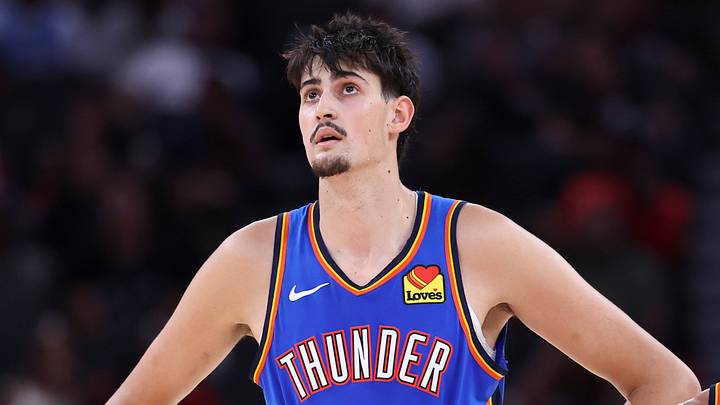
After adding another 7-footer to an already crowded frontcourt, Oklahoma City opened its season with a 116-104 victory over San Antonio, holding Wembanyama to 12 points on 1-of-13 shooting. For the Cleveland Cavaliers, the more important story might be what Oklahoma City did before the game.
Wembanyama might be creating the NBA's next arms race
O'Neal forced opponents to think beyond their starting centers. Teams needed additional size, available fouls and enough physical defenders to withstand his punishment over an entire series.
Wembanyama is creating a different kind of problem. At 7-foot-4, he combines extraordinary length with mobility, shooting range and defensive versatility. Containing him requires more than simply putting a large body between him and the basket. Oklahoma City's frontcourt construction is particularly intriguing.
The Thunder already had Chet Holmgren, Isaiah Hartenstein, Thomas Sorber and Jaylin Williams. Yet they still invested the 12th overall pick in the 2026 NBA Draft on 7-foot-3 center Aday Mara. That decision followed Oklahoma City's seven-game loss to San Antonio in the Western Conference Finals.
There is no confirmation that Mara was drafted specifically to counter Wembanyama. Still, the timing raises an interesting possibility. Oklahoma City might recognize that beating San Antonio requires more defensive options than its existing rotation provides.
Mara contributed seven points in 12 minutes during the opener. He wasn't solely responsible for Wembanyama's struggles, but the Thunder's collection of big men gave them options. That's the lesson Cleveland should consider.
The Cavaliers have two excellent big men, but is that enough anymore?
Evan Mobley and Jarrett Allen aren't the problem. They're arguably Cleveland's greatest defensive advantage. Mobley provides exceptional mobility, rim protection and the ability to defend across positions. Allen supplies interior strength, rebounding and efficient finishing around the basket.
Together, they give the Cavaliers a frontcourt capable of challenging almost anyone. But what happens when one needs rest, gets into foul trouble or encounters an assignment that requires a different defensive approach? That's where Cleveland's depth becomes more concerning.
Thomas Bryant offers experience and offensive production, but defensive versatility isn't his defining strength. Khalifa Diop provides additional size and developmental potential, although he remains largely unproven against NBA competition.
Compare that with Oklahoma City, which has continued investing in frontcourt personnel despite already possessing championship-caliber talent. The distinction isn't simply how many centers a team carries. It's whether those centers can provide meaningful defensive resistance against an opponent like Wembanyama.
A hypothetical Finals matchup against San Antonio could demand several capable defenders, not just two outstanding starters. And Cleveland cannot assume Mobley and Allen will handle every difficult possession themselves.
Cleveland can't wait until the NBA Finals to solve a Wembanyama problem
The Cavaliers have immediate obstacles. The defending champion New York Knicks remain a threat, while Philadelphia's star-studded roster presents another difficult Eastern Conference challenge. Cleveland has to navigate those opponents before worrying about San Antonio, since championship planning cannot stop at the conference finals. Oklahoma City's approach suggests the value of preparing for a potential postseason rival before that matchup arrives.
The Cavaliers should consider doing the same. That doesn't require trading Allen, changing the starting lineup or abandoning the Mobley-Allen partnership. It means evaluating whether another defensively capable center could strengthen the rotation. Ideally, that player would provide additional rim protection, absorb difficult assignments and survive physical matchups without creating another obvious defensive weakness.
Just as importantly, he would reduce the pressure on Mobley and Allen to remain effective for every critical minute. Cleveland doesn't necessarily need another star, but it might need another specialist. The Cavaliers have invested heavily in their championship aspirations, particularly after acquiring James Harden to complement Donovan Mitchell.
If the goal is to compete for a title now, overlooking a potential weakness because it might not become relevant until June would be shortsighted. Oklahoma City's opening-night performance doesn't establish a league-wide trend.
But its roster decisions suggest the possibility of something bigger. Wembanyama might already be changing how championship contenders build their teams. If Cleveland intends to be among those contenders when June arrives, it cannot afford to be the last team to adjust.
 Add us as a preferred source on Google