

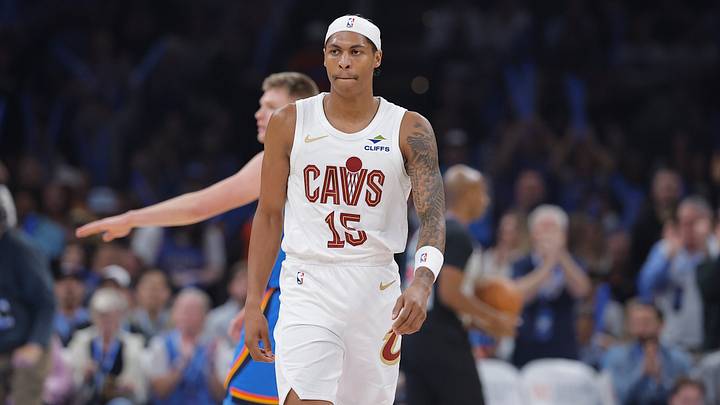
Starting Meleek Thomas over James Harden sounds ridiculous. We're talking about benching a former MVP, one of the greatest offensive players of his generation, for a rookie who has barely gotten his NBA career off the ground. Before anybody starts questioning my basketball credentials, bear with me for a moment. The Cleveland Cavaliers' early-season numbers suggest this supposedly outrageous idea deserves serious consideration.
This isn't an argument that Thomas is a better basketball player than Harden. It's an argument that the Cavaliers might be a better basketball team with Thomas starting alongside Donovan Mitchell and Harden running the second unit. This current lineup is so topsy-turvy, there’s no real reason to salvage it. Heck, migh as well experiment earlier rather than later in the season anyway, right?
The numbers are making a case Kenny Atkinson shouldn't ignore
Through Cleveland's first 10 games, Harden is averaging 15.7 points in 33.4 minutes while shooting 36.6 percent from the field. Thomas, meanwhile, is averaging 12.3 points in just 22.5 minutes, shooting 45.1 percent overall and 45 percent from three. That comparison becomes considerably more interesting when adjusted for playing time.
Thomas is producing approximately 19.6 points per 36 minutes, compared with Harden's 16.9. Give Thomas Harden's 33.4 minutes, and his current scoring rate projects to roughly 18.2 points per game. Nobody should mistake that projection for a guarantee. More minutes bring tougher defensive assignments, fatigue and additional responsibilities. However, the numbers suggest Cleveland wouldn't necessarily sacrifice offensive production by making the switch.
The lineup data offers an even more compelling argument. Cleveland has posted an approximately plus-17 net rating per 100 possessions when Mitchell and Thomas share the floor. Mitchell and Harden, by comparison, are barely above even at plus-one. That's a 16-point difference in net rating between the two pairings.
The samples are small, and those combinations aren't mutually exclusive, but the contrast is difficult to dismiss when the Cavaliers are struggling to establish any offensive consistency. Harden's overall on/off numbers add to the concern. Cleveland has been outscored by 2.3 points per 100 possessions with him playing while outscoring opponents by 14.9 when he sits.
At some point, Atkinson has to stop looking exclusively at the names on his roster and start examining which combinations are actually producing results.
Donovan Mitchell doesn't need Harden to run his offense
One of the strongest objections to starting Thomas is that Harden remains a substantially better playmaker. He's averaging 5.8 assists, while Thomas is averaging just one. Fortunately, Cleveland already employs Donovan Mitchell.
Mitchell has spent much of his career operating as a primary ball-handler, creating his own offense and initiating possessions for teammates. He's averaging 5.6 assists this season, demonstrating that he can distribute without sacrificing his scoring responsibilities. The Cavaliers don't need to reinvent Mitchell's game to make this work. They need to give him greater control over an offense that has become crowded with ball-dominant players.
Harden's presence demands touches, time and possessions that might otherwise belong to Cleveland's best scorer. The numbers don't establish that Harden is personally suppressing Mitchell's production, but they provide enough reason to question whether the partnership is maximizing either player.
Thomas offers a different dynamic. His perimeter shooting and willingness to score without monopolizing possessions could create more room for Mitchell to dictate the offense. Even Thomas' individual scoring splits point toward the possibility. In one available teammate-split sample, he averaged 14.8 points per 36 minutes alongside Harden compared with 32.3 without him.
That second figure comes from a tiny sample and shouldn't be treated as sustainable. It does, however, reinforce the argument that Thomas deserves an opportunity in a different offensive arrangement.
James Harden could give Cleveland's bench exactly what it needs
Moving Harden to the bench wouldn't mean removing him from the rotation or pretending his extraordinary career never happened. It would mean using his remaining strengths where they might provide the greatest advantage.
Harden can still organize an offense, create opportunities for teammates and control the pace. Those abilities could become invaluable when Mitchell rests and Cleveland needs somebody capable of running the second unit.
Instead of forcing two high-usage guards to divide the same possessions, Atkinson could stagger their minutes, giving Mitchell command of the starters and Harden responsibility for keeping the bench productive. The Cavaliers would gain a genuine offensive organizer for their reserves while allowing Thomas to develop alongside their franchise centerpiece.
There's a reasonable concern about Thomas' defense and whether his efficiency would survive a larger role. That's precisely why Cleveland should test the arrangement rather than declare it a permanent solution. A few games would provide more useful information than another month of wondering whether the existing backcourt will suddenly find its rhythm. The bigger obstacle might be accepting what such a change represents.
Harden has spent his career being treated like a superstar. Asking him to embrace a reserve role would require an adjustment in status, even if his playing time remained substantial. However, the Cavaliers aren't obligated to preserve anybody's preferred position in the hierarchy. They're obligated to win basketball games. Starting the rookie over Harden sounds absurd until the numbers enter the conversation. Then it starts sounding like an experiment Cleveland has every reason to consider.
Maybe it's time for the Cavaliers to stop appealing to egos and start appealing to winning.
 Add us as a preferred source on Google