

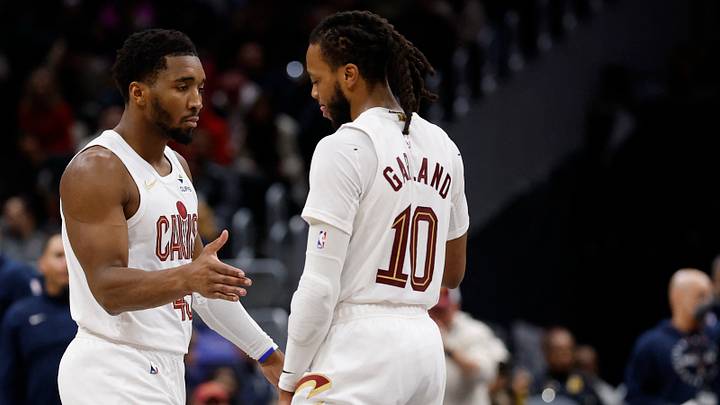
The grass isn't always greener on the other side, and the Cleveland Cavaliers are discovering that the hard way after trading Darius Garland for James Harden.
When Cleveland acquired Harden from the Los Angeles Clippers in February, the move looked like a masterstroke. The Cavaliers had exchanged a fringe All-Star for a former MVP who appeared to have discovered the fountain of youth, and the early returns suggested their front office had outsmarted everybody.
Harden was coming off an impressive stretch in Los Angeles, averaging 25.4 points and 8.1 assists before the trade. Cleveland subsequently reached the Eastern Conference Finals, seemingly validating its decision to sacrifice Garland for an established superstar. Several months later, however, that supposedly brilliant move isn't looking nearly as intelligent.
The trade has had time to marinate, and the Cavaliers might finally be realizing that the grass they were admiring on the other side was mostly fool's gold.
Darius Garland is outperforming James Harden
Through Cleveland's first 10 games, Harden is averaging 15.7 points and 5.8 assists while shooting an ugly 36.6 percent from the field. Meanwhile, Garland is averaging 21.2 points and seven assists for the Clippers, connecting on 47.1 percent of his shots and 37.1 percent from beyond the arc.
That's a difference of 5.5 points and 1.2 assists per game, with Garland shooting more than 10 percentage points better from the field. The Cavaliers traded away the younger player, and that younger player is currently delivering the superior production.
Garland is 26. Harden is 37. Garland is faster, quicker, more efficient and entering what should be the prime of his career. Harden is approaching the stage when even legendary players discover that their bodies no longer cooperate with their reputations. Sure, Garland has his shortcomings, including an alarming 5.1 turnovers per game this season. However, his offensive production makes it increasingly difficult to argue Cleveland upgraded its backcourt.
Perhaps this comparison would've been laughable during Harden's 2017-18 MVP campaign, when he averaged 30.4 points and terrorized opposing defenses with an almost unstoppable combination of scoring and playmaking. Unfortunately for Cleveland, this isn't 2018. Every passing game offers another painful reminder that the Cavaliers didn't acquire MVP Harden. They acquired a diminished version of the superstar he once was.
James Harden's playoff run might have been fool's gold
Cleveland had reasons to believe Harden represented an upgrade. His late-season production and the Cavaliers' subsequent playoff run made the front office look like geniuses. However, even that postseason success deserves another examination.
Harden averaged 19.2 points and 5.5 assists across 18 playoff games, respectable production that helped Cleveland reach the conference finals. Yet he shot just 41 percent overall and 29.9 percent from three. Against the New York Knicks, the numbers deteriorated further.
Harden averaged 16 points and three assists while shooting 38.9 percent from the field and an atrocious 17.9 percent from three during Cleveland's four-game elimination. Those weren't exactly the numbers of a superstar dragging his team toward a championship. Maybe Cleveland became so enamored with reaching the conference finals that it overlooked the warning signs appearing along the way.
Harden could still summon impressive performances, but sustaining that production against elite competition was becoming another matter entirely. What looked like a late-career renaissance might have been the final flicker of a superstar whose best basketball was already behind him. Now, with Cleveland sitting at 5-5 and Harden struggling to score efficiently, those warning signs are becoming increasingly difficult to ignore.
Cleveland sacrificed its future for yesterday's superstar
The most frustrating aspect of this trade is that the Cavaliers already had a talented point guard capable of growing alongside Donovan Mitchell. Garland wasn't perfect. His playoff shortcomings and defensive limitations were legitimate concerns, and Cleveland had reasons to question whether its undersized backcourt could win a championship.
However, Garland was also a two-time All-Star who hadn't reached his prime. Trading him meant surrendering years of potential development for a player whose remaining productive seasons were always going to be limited. Imagine Cleveland entering this season with Garland and Mitchell still sharing the backcourt. The Cavaliers would have two dynamic scorers capable of creating their own offense, with Garland's quickness and playmaking complementing Mitchell's ability to take over games.
There's no guarantee that pairing would've solved Cleveland's postseason problems. However, the early numbers suggest the Cavaliers would at least have retained the more productive point guard, with considerably more years of high-level basketball ahead of him. Instead, Cleveland committed to an aging superstar whose declining efficiency has made the entire experiment look increasingly questionable.
The organization essentially traded tomorrow for today, only to discover that today might not be nearly as promising as advertised. Ten games aren't enough to deliver a final verdict on an NBA season. They are, however, enough to recognize when a supposedly obvious upgrade deserves serious reconsideration.
Cleveland thought it was trading a fringe All-Star for a superstar. What it actually surrendered was a younger, quicker and currently more productive player for the fading reputation of one. The Cavaliers gambled on James Harden's past greatness instead of Darius Garland's future, and the early returns suggest they didn't just make the wrong bet. They traded away the better player to make it.
 Add us as a preferred source on Google