

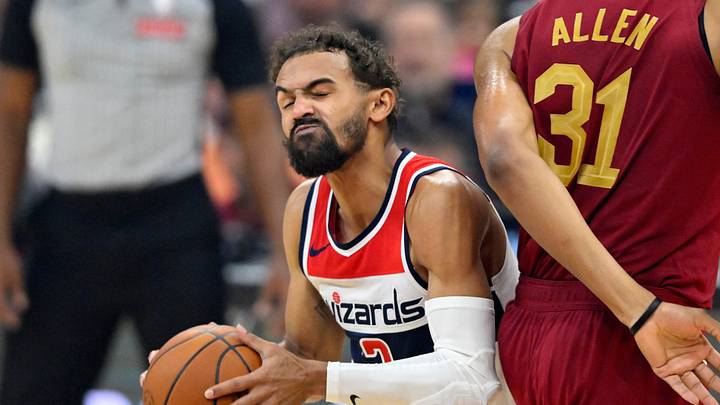
Anthony Davis and Trae Young arrived in Cleveland with something to prove. Both have experienced the kind of career setbacks that can leave former franchise cornerstones eager to remind the league of what they're capable of accomplishing. The Cleveland Cavaliers had every reason to take that motivation seriously.
Wednesday night's 121-111 victory over the Washington Wizards presented Cleveland with an opportunity to test itself against two accomplished offensive players. Davis remains a talented interior scorer, while Young has spent years tormenting opposing defenses with his shooting and playmaking. Neither delivered the offensive performance Washington needed.
Davis finished with 18 points on 8-of-18 shooting, while Young scored 14 points on 3-of-12 from the field. The pair combined for just 32 points on 36.7 percent shooting, a disappointing return for two players capable of taking over games.
Those numbers alone don't prove Cleveland's defense was responsible for every missed shot. But the Cavaliers' second-half turnaround demonstrated how much more difficult Washington's offense became when Cleveland finally began getting stops.
Trae Young couldn't find his usual offensive rhythm
Young is dangerous because his impact extends beyond scoring. His ability to manipulate defenders, create passing lanes and force difficult decisions in pick-and-roll situations can make an entire offense more productive. Against Cleveland, he still managed eight assists, showing that he could contribute even without a productive shooting night. But his individual offense never developed.
Young connected on just one of his seven three-point attempts and committed four turnovers. For a player accustomed to controlling possessions with his shooting threat, that lack of efficiency limited his ability to dictate the game.
Some of those misses were undoubtedly shots Young would expect to make. Cleveland shouldn't receive automatic credit simply because an opposing star had a difficult night from the field. Young's inability to establish a consistent scoring rhythm became increasingly important as Washington's offense slowed after halftime.
The Cavaliers have the personnel to make life uncomfortable for perimeter creators. Evan Mobley's mobility provides valuable defensive flexibility, while Jarrett Allen offers another presence near the basket. Those advantages matter against guards who thrive on forcing defenders into difficult choices.
Cleveland didn't completely eliminate Young's playmaking, but it prevented his scoring from becoming the deciding factor.
Anthony Davis failed to capitalize on Washington's early advantage
Davis presented Cleveland with a different challenge. Even at this stage of his career, he possesses the size, skill and experience to punish opponents around the basket. His offensive versatility makes him difficult to defend when he establishes favorable positioning and finds a comfortable rhythm.
The Cavaliers certainly didn't prevent Washington from having success inside. The Wizards scored 66 points in the paint and shot 53 percent from the field overall, numbers that make it impossible to describe Cleveland's entire defensive performance as dominant.
Washington's first-half production was especially concerning. The Wizards scored 42 points in the opening quarter and entered halftime with 69, exposing Cleveland's defensive inconsistency and putting the Cavaliers in another uncomfortable position. Yet Davis never turned that early advantage into an individually dominant performance.
He finished with five rebounds and three assists alongside his 18 points. His shooting numbers reflected an ordinary offensive night rather than the kind of performance that could carry Washington through Cleveland's eventual comeback.
The Cavaliers didn't shut down Washington's entire frontcourt, and Davis wasn't completely ineffective. But when the Wizards needed their most accomplished big man to help stabilize the offense, he couldn't provide enough scoring to stop Cleveland's momentum. For a team featuring Mobley and Allen, preventing an opponent of Davis' caliber from taking over is encouraging, even if the overall interior defense still needs improvement.
Cleveland's second-half adjustment changed the game
The most meaningful defensive development came after halftime. Washington entered the break leading by 10 points, having scored 69 against a Cleveland team that appeared unable to consistently string together stops. The Cavaliers responded by holding the Wizards to 23 points in the third quarter and just 19 in the fourth. That amounted to 42 second-half points, a dramatic reduction from Washington's opening-half production.
Cleveland outscored the Wizards 62-42 over the final two quarters, transforming a double-digit deficit into a double-digit victory. There are multiple factors behind a scoring decline that significant. Washington's shooting cooled, and its offensive execution became less productive as the game progressed. Not every missed jumper or empty possession should be attributed to a successful defensive adjustment.
But Cleveland deserves recognition for its collective response. The Cavaliers were no longer allowing Washington to score at the extraordinary pace it established early. They began producing the stops necessary to create opportunities on the other end, allowing their offensive talent to take control.
That is the defensive identity Kenny Atkinson needs his team to establish. Cleveland has enough size, athleticism and experience to challenge opposing offenses without waiting until the second half to become competitive defensively. The challenge is sustaining that effort from the opening tip.
 Add us as a preferred source on Google