

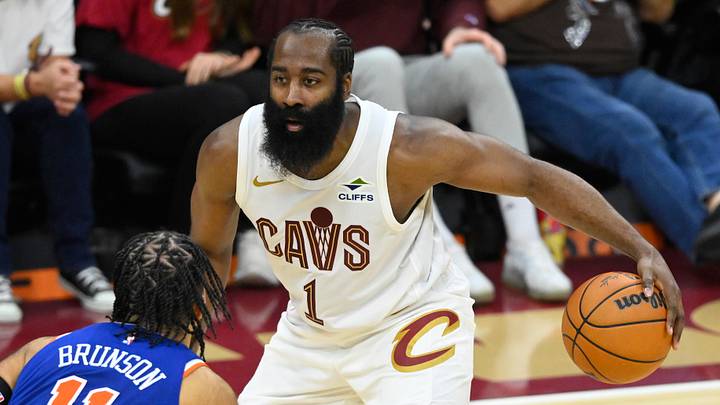
There comes a time when even the most dependable workhorse needs to be put out to pasture. The Cleveland Cavaliers are approaching that uncomfortable moment with James Harden, and pretending otherwise won't make the inevitable any easier. Saturday's 109-97 loss to the New York Knicks offered another reminder that the player Cleveland is paying for and the player actually taking the floor are becoming two very different people.
Harden scored seven points on 2-of-9 shooting in 34 minutes, finishing with five assists and a minus-15 rating. Meanwhile, Donovan Mitchell poured in 37 points trying to keep Cleveland competitive against the same Knicks team that swept the Cavaliers out of last season's Eastern Conference Finals. The Beard was once among the most feared offensive weapons in basketball. These days, nobody seems particularly frightened of the Beard anymore.
At 37, Harden is averaging 15.7 points on 36.6 percent shooting through 10 games. Those numbers are difficult to reconcile with the three-year, $97 million contract Cleveland handed him this summer. The Cavaliers are paying for a superstar's reputation while receiving production that no longer resembles one.
Aging superstars rarely recognize when the applause has stopped
The cruel irony of professional sports is that the irrational confidence required to become an all-time great can eventually become the very thing that makes accepting decline impossible. Allen Iverson provided a painful example in 2009. After joining Memphis, the former MVP immediately bristled at being used as a reserve. "I'm not a bench player. I'm not a sixth man," Iverson insisted.
His résumé was extraordinary. Unfortunately, his résumé couldn't score points in 2009. Iverson played just three games for Memphis before the relationship unraveled. Carmelo Anthony delivered an even more memorable demonstration during his introductory press conference with Oklahoma City in 2017.
When a reporter suggested he might come off the bench, Anthony looked genuinely amused. "Who me?" he responded before turning toward Paul George. "Hey P, they said I gotta come off the bench." It was hilarious at the time. In retrospect, the warning signs were practically waving themselves.
Anthony averaged 16.2 points on 40.4 percent shooting that season. After Oklahoma City's first-round playoff exit, he again rejected the possibility of a reserve role. The Thunder moved on that summer. Anthony eventually accepted a smaller role in Portland, proving adaptation was possible. It simply came after his resistance had already helped turn a difficult transition into an uncomfortable departure.
The late, great Kobe Bryant offers another lesson, although his situation was different. In 2013, the Lakers rewarded Bryant with a two-year, $48.5 million extension. During the final season of that agreement, the Black Mamba averaged 17.6 points while shooting just 35.8 percent from the field. He was still Kobe Bryant in name, reputation and competitive spirit. On the hardwood, however, the devastating scorer who once terrorized defenses was no longer there consistently.
Los Angeles chose to honor its franchise legend, even as his production declined. However, if the Lakers had prioritized the organization's future over preserving Bryant's superstar status, they would have directed that money toward rebuilding the roster rather than paying a declining player like he was still in his prime. That decision might have been understandable for a rebuilding team celebrating an icon's final chapter, but it came at a cost to the organization's ability to move forward.
Cleveland doesn't have that luxury. The Cavaliers aren't staging a farewell tour. They're supposedly chasing a championship with Mitchell in his prime, and every possession spent protecting an aging star's status comes at a potential cost to that pursuit.
Cleveland must choose winning over protecting Harden's reputation
Nobody is suggesting Harden has forgotten how to play basketball. His passing and experience still have value, and one terrible performance doesn't erase an accomplished career. However, Cleveland cannot keep treating yesterday's greatness as a guarantee of tomorrow's production.
The organization needs to begin reducing Harden's minutes, redistributing offensive responsibilities and determining whether he can contribute without commanding the privileges of a franchise centerpiece. That conversation becomes considerably more complicated when a former superstar believes he's still the player opponents once feared.
Iverson and Anthony demonstrated how quickly reduced minutes and fewer shots can become public disputes. Harden hasn't publicly rejected a smaller role, but Cleveland would be foolish to assume the transition will be effortless.
There's also the financial reality. Harden's contract includes a player option for 2028-29, potentially extending Cleveland's commitment well beyond the point when his production justifies his salary. The Cavaliers must seriously consider parting ways while Harden retains enough value to make a separation possible.
We're not disrespecting his legacy, but we're refusing to let nostalgia hold the organization hostage. Sometimes preserving a great player's dignity means recognizing the warning signs before the relationship deteriorates into resentment, public frustration, and an unceremonious exit.
The old workhorse has carried enormous loads throughout his career. Nobody can take that away from him. However, Cleveland cannot keep hitching its championship ambitions to a player whose best miles appear to be behind him. The Cavaliers need to put the organization first and find a way to put the Beard out to pasture before they're forced to drag him there kicking and screaming.
 Add us as a preferred source on Google