

The Cleveland Cavaliers entered the preseason with a fairly straightforward plan. Their stars would carry the championship expectations, their veterans would provide stability, and their younger players would compete for whatever minutes remained.
Three exhibition games later, that last part doesn't look quite so straightforward. Jaylon Tyson has looked too good to treat like an afterthought. Craig Porter Jr. has made a legitimate case to run the second unit. Meleek Thomas has flashed the kind of scoring ability that makes keeping him on the bench a difficult proposition.
And Peyton Watson might already be the most important piece of Cleveland's revamped supporting cast.
The Cavaliers aren't suddenly rebuilding. They're trying to win a championship. But their preseason revealed an interesting problem for Kenny Atkinson: Cleveland's younger players might deserve more responsibility than its rotation can comfortably accommodate.
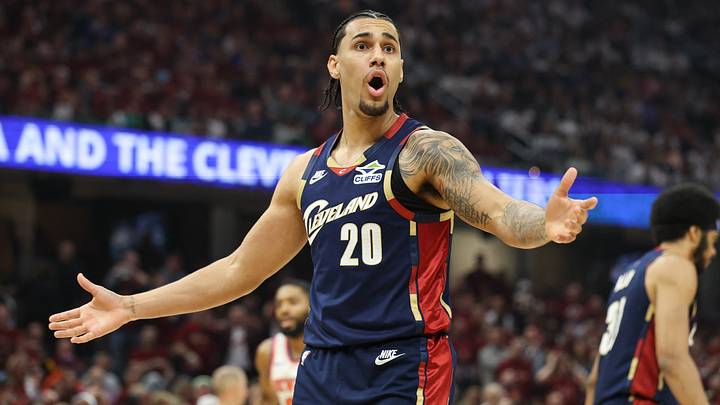
Jaylon Tyson is making the sixth-man conversation very interesting
If there was one young Cavalier who strengthened his case throughout the preseason, it was Tyson.
The third-year wing averaged 13.0 points across Cleveland's three exhibition games, shooting 60 percent from the field and 50 percent from three-point range.
Those aren't numbers to build an entire season around. But they're encouraging evidence from a player who already established himself as one of the league's most accurate three-point shooters last season.
Tyson isn't simply fighting for a place in the rotation anymore. He's making a case to become one of its most important reserves. The complication is Watson.
Cleveland's new starting small forward brings defensive versatility that Tyson doesn't necessarily replicate. Watson's ability to challenge shots, defend opposing wings and provide resistance at the point of attack gives the Cavaliers something they desperately need alongside their offensive-minded backcourt. That makes Watson the logical starter and Tyson the logical sixth man.
It's a compelling arrangement, provided Atkinson doesn't treat Tyson as merely the player who replaces Watson. Tyson should get opportunities alongside Watson, too. Those combinations could give Cleveland a more athletic, versatile perimeter group without sacrificing as much offensive firepower.
The question isn't whether Tyson deserves minutes. It's how many Cleveland can afford not to give him.
The backup point guard battle just got a lot more interesting
Porter entered the preseason with something to prove. He responded by averaging 5.6 assists across three games, including a 10-assist performance against Boston. For a Cavaliers team that needs reliable offensive organization when its stars rest, that's meaningful.
Porter doesn't need to dominate the ball or produce highlight-reel scoring performances to be useful. His ability to organize possessions, find teammates and contribute defensively makes him a natural candidate for the backup point guard job.
Unfortunately for Porter, Thomas apparently didn't receive the memo that rookies are supposed to wait their turn.
The second-round pick scored 16 points in just under 13 minutes during Cleveland's preseason finale against Orlando, shooting 6-of-9 from the field and 2-of-3 from beyond the arc. That performance followed earlier flashes of scoring and defensive activity.
Thomas offers a different kind of value than Porter. He's a more aggressive scoring threat, capable of injecting energy into an offense that occasionally needs someone willing to attack. Tyrese Proctor remains part of the competition, too.
But Cleveland's limited backcourt minutes make this more than a question of which young guard looks promising. Atkinson must decide which skill set his second unit actually needs.
Cleveland's ideal rotation might leave a promising player watching
The starting five appears settled: James Harden, Donovan Mitchell, Watson, Evan Mobley and Jarrett Allen. Behind them, Tyson and Sam Merrill should command significant wing minutes, while Mario Hezonja and Thomas Bryant provide frontcourt depth. That leaves the backup point guard position as the most obvious opening in a potential 10-man rotation. Based on the preseason, Porter has earned the first opportunity.
His playmaking offers a complementary skill set, particularly with Tyson and Merrill available to finish possessions. Thomas could then serve as a situational scoring option, with Proctor providing additional depth.
But that shouldn't mean Thomas disappears into developmental purgatory.
Atkinson could experiment with smaller lineups featuring Porter and Thomas together, or give Thomas opportunities when Cleveland needs another offensive spark. The key is avoiding a rotation so rigid that it prevents young players from earning bigger roles.
As the Cavaliers' rotation could look very different, preseason performances have given Atkinson reasons to rethink how his supporting cast fits together.
Of course, exhibition basketball isn't the playoffs. Thomas still needs to prove he can handle NBA defensive assignments consistently, and Porter must show his playmaking translates against regular-season rotations. Cleveland's younger players have done enough to make the competition legitimate, though.
That's a welcome problem for a contender whose future cannot depend exclusively on its established stars. The Cavaliers already know who their best five players are. The preseason made figuring out the next five considerably more interesting.
 Add us as a preferred source on Google