

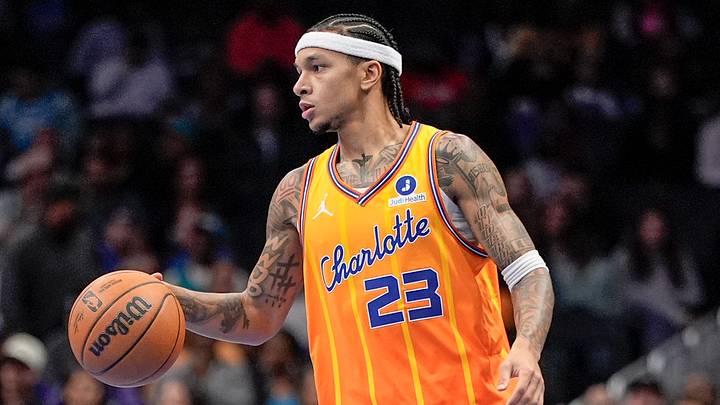
When the Cleveland Cavaliers traded Dennis Schroder to the Charlotte Hornets last Friday for Tre Mann, the motivations and endgame for Cleveland were quite clear.
By making the move, the Cavaliers shed over $6 million from their payroll for the upcoming season as well as an additional $22 million (Mann and Schroder’s combined salaries) if they decline Mann’s club option in 2028. For months it was clear that Cleveland was looking to cut costs, especially with James Harden’s contract not even on the books yet, and dealing Schroder was a shrewd piece of business.
So, while the acquisition of Mann himself was likely not the purpose of the trade, his value remains under the radar for a team that could use some creation on their bench units, especially without Schroder. Can the Cavaliers look at Mann's recent past to find the best way to deploy him?
The answer is yes. Mann's track record of playing efficient, winning basketball is spotty at best, but there have been stints, eras or moments (whatever you'd like to call them) in his career where he has shown very real flashes.
Let's take a look at where he has been to learn how he can provide what Cleveland needs in the present.
Mann’s beginning in Charlotte was promising
Over his career, Mann has averaged 8.5 points per game on 40.2 percent from the field and 34.5 percent from three. In totality, those numbers are average no matter how one looks at them. But, his first 28 games in a Charlotte uniform in 2023-24 were amongst the most promising of his young career.
During that time, he averaged 11.9 points and shot 45.3 percent from the field and 36.4 percent from deep, including a 21 point, 8 rebound and 6 assist performance in a win over Atlanta on Feb. 14, 2024. Not to mention, he started all 28 of his games for Charlotte that season as well.
Charlotte’s most used lineup in 2023-24, per databallr.com, played 109 minutes together and consisted of Mann, Vasilije Micic, Brandon Miller, Miles Bridges and Nick Richards. However, despite the frequency, that lineup graded out poorly (which should be unsurprising for an uncompetitive team in a given season) and came in at a -9.1 net rating. The offense came in at slightly below average, but the defense was abysmal with a defensive rating of 123.3.
On a more positive note, Mann’s best lineup with the Hornets that season that played over 30 total minutes included once again Mann, Miller and Richards but also Seth Curry and Grant Williams. This group put together a +3.6 net rating and in this case, the defensive rating skyrocketed to an impressive 92.7. However, the offense struggled, grading out at just 96.3
So, to maximize defensive efficiency, it appears paramount to have strong wing defenders like Williams and Miller to shield the slender Mann from too many difficult responsibilities. Offensively, the Hornets appeared to be better served when Mann was not the primary ball handler in a lineup. While clearly pairing Mann and Micic was a nightmare on the defensive end, it was actually beneficial offensively so that Mann didn’t have the all-encompassing role as lead creator while instead embodying a more fitting off-ball role.
Mann’s fit in Cleveland will be delicate
Given all of that, how Mann will align in the Cavaliers’ rotation will be questionable. Clearly, he’ll come off the bench and be a backup guard in some capacity, but who best to group him with is questionable.
Based on the numbers from the strongest meaningful sample size of his career, Mann will be better served to play alongside a true lead guard. Harden is the clearest option, a true point guard who dictates a game. Donovan Mitchell works too, but not quite as well as he exists in a similar offensive space to Mann. In terms of bench players only, Craig Porter Jr. is most likely the best guard to play next to Mann.
This brings up the logjam that is Cleveland’s guard depth. The team has both Meleek Thomas and Tyrese Proctor, who are both best served by playing in that off-ball role that we already established Mann is best in. Not just that, but time and potential is not on Mann’s side in this case compared to the recent draft capital used on Thomas and Proctor.
Anyways, for bigger wings and forwards that fit with Mann on the floor, the first and most obvious thought is that the absence of Dean Wade will be sorely missed. He presents the perfect insulating forward for almost all smaller guards and would have been an excellent fit for Mann. But, alas, Wade is gone and the next most obvious guy for the role is Jaylon Tyson. As he grows into his potential, he should continue to provide the physicality necessary to make up for Mann’s lack thereof.
Max Strus and his perkiness could also survive with Mann, but it’s hard to see Mann and the likes of a Sam Merrill thriving together at the same time. That said, the twin towers of Evan Mobley and Jarrett Allen make life easier for any of their teammates defensively, which will give the Cavaliers more leeway to experiment with what works for them.
All in all, if Mann’s small sample size of success in Charlotte is any indication, he is best utilized with a true point guard next to him along with the insulation of physical wings if he is to be a positive player in a winning environment.
 Add us as a preferred source on Google