

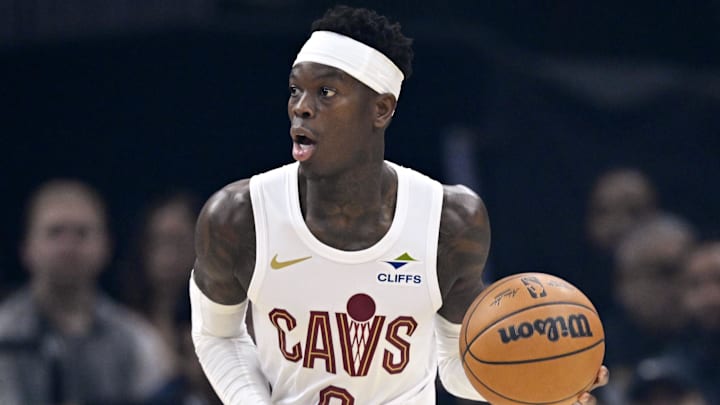
As the NBA Playoffs roll on, the margins get thinner and the competition gets tougher. While the Cleveland Cavaliers are still very much alive, there are certainly some things to be addressed.
Perhaps first and foremost should be the team's depth, especially in the backcourt. Between Dean Wade, Max Strus, Sam Merrill, Jaylon Tyson and Keon Ellis, Cleveland has no shortage of role-playing wings (although none have been consistently excellent), but the backcourt is a different story.
Obviously, James Harden and Donovan Mitchell handle the bulk of the work, but for any team with championship aspirations, that is not quite enough. The only other guard to get much time has been Dennis Schroder, whose results are mixed at best.
So, to see how the Cavaliers could fix this growing issue, they should look to a Western Conference foe that is very much thriving: the Minnesota Timberwolves.
When Anthony Edwards went down with a knee injury in the first round against the Denver Nuggets, many wrote off Minnesota. However, thanks to key play from the backcourt depth (and the heroics of Jaden McDaniels and Rudy Gobert, of course), the Timberwolves were able to stay afloat and advance.
If, for any reason, either Harden or Mitchell got hurt, Minnesota has provided the blueprint on how to build a backcourt rotation.
The Timberwolves found their depth in a variety of places
Perhaps the biggest key for creating such a quality backcourt has been Minnesota's ability to find talent in all sorts of fashions, including the draft, trades, and free agency -- both with veterans and 'failed' youngsters.
To start with the most recent results, there has hardly been a more welcome emergence than that of Terrence Shannon Jr. While some view him as purely a wing at this point, he's handled more of the offensive load than some might expect. In fact, Shannon Jr. has a 23.9 percent usage rate, the highest of any Minnesota player not named Anthony Edwards or Julius Randle these playoffs.
Behind a lightning-quick first step, Shannon Jr. has been a sparkplug for the Timberwolves' offense. He's averaging 14.5 points per game and has been just what Minnesota has needed following the injuries to both Edwards and Donte DiVincenzo, not to mention Ayo Dosunmu.
Speaking of Dosunmu, before the calf injury that has sidelined him since Game 5 of the Denver series, he was paramount for Minnesota. Things looked bleak in the wake of Edwards' departure, but Dosunmu saved the day to the highest extreme.
He exploded for 43 points in Game 4, going 13-17 from the field and 5-5 from three. In the five games he's played in these playoffs, Dosunmu has averaged 21.8 points per game on a whopping 60.9 percent from the field and an even more absurd 54.5 percent from three. His ability to play both on and off the ball has been key for a group looking an offensive identity, and his return should elevate Minnesota's potency.
The reemergence of Mike Conley was also hugely important, especially in Game 1 against the San Antonio Spurs. In that game, Conley recorded 12 points and six assists, but his impact extends beyond the box score. He stabilized and initiated sets, giving Minnesota structure amidst the defensive juggernaut of Victor Wembanyama and Stephon Castle, among others. Even with the return of Edwards and potentially Dosunmu, Conley has more than earned a spot in the rotation as a leader and facilitator.
Lastly, while he's had a lesser role than the previous three guys, Bones Hyland has been an overall positive as well. His minutes have certainly varied, but in Game 5 against Denver, he was huge. Hyland scored 15 points, and while Minnesota lost the game, they found a spark plug that they can rely on going forwards.
The Cavaliers need to emulate what Minnesota has done
As stated above, the Timberwolves built this backcourt in a variety of ways. Conley has been on the decline for years, but Minnesota has made the conscious choice to retain him. Nobody wanted Hyland and now he's scored in double figures in a playoff game. Dosunmu was the key deadline acquisition in February and Shannon Jr. was the older prospect that Minnesota took a swing on in the draft.
The Cavaliers need to embrace that variety and implement it themselves. Again, Schroder just has not cut it. The veteran is averaging 6.6 points on 37.5 percent shooting and 23.5 percent from three in just 13.7 minutes. That is nowhere near good enough, even with a healthy Harden and Mitchell. Imagine one of the two of them having an injury such as Anthony Edwards did, and all of a sudden the Cavaliers are absolutely scrambling for answers.
The easiest way to address the backcourt depth is to look to the draft. Picking at the end of the first round, Cleveland will have options and a variety of styles to choose from. At least one of Tyler Tanner, Ebuka Okorie or Braden Smith will almost certainly be available at 29, plus the Cavaliers could also explore trading up. A guy like Christian Anderson or Bennett Stirtz could do wonders for this group.
Cleveland probably won't want to splurge on a big guard signing, given both its tight financial situation as well as the presence of Mitchell and Harden, but there will be cheaper options. There will be a multitude of directions the Cavaliers could go in free agency, from D'Angelo Russell to Tyus Jones to Marcus Smart, among many others. Also, for the record, all three of Conley, Dosunmu and Hyland will all be on the market this summer.
Trades are also an option, but Cleveland could utilize that market to perhaps get off of Schroder's deal. He has two years remaining, making over $30 million total, so it would do the Cavaliers wonders to potentially get him off the books.
Lastly, Cleveland could also look in-house for adjustments. 2025 second-round pick Tyrese Proctor hasn't necessarily been developed as a point guard this year, but he's played it in the past at Duke and in high school. The wing room is crowded anyway, so if the front office believes in him, Proctor could be the simplest answer.
In any case, the guard depth is an issue that remains to be solved, and the Cavaliers should look at the success of teams like Minnesota on how to build out a competent rotation in the backcourt.
 Add us as a preferred source on Google