

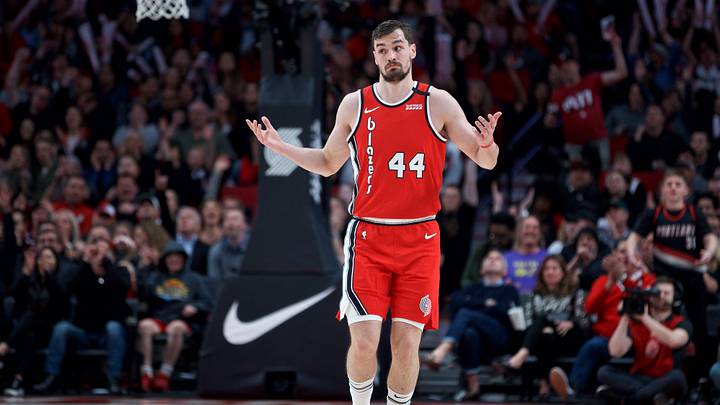
Of all of the players on this fascinatingly constructed Cleveland Cavaliers’ roster, there may be no bigger ‘wildcard’ than the newly signed Mario Hezonja.
The Croatian-born international was the fifth overall pick back in 2015 and had an average NBA career, spanning five seasons and three teams, with his best season coming with the Orlando Magic in 2017-18 when he averaged 9.6 points per game.
There were many factors leading to Hezonja’s departure for Europe in 2020, first and foremost, his inconsistency with his jumper. Across his careeer, Hezonja shot 41.7 percent from the field and just 31.9 percent from 3. He never became an impactful defender or passer either, leading to his value diminishing at a high rate once the flair of a top-five draft pick wore off.
However, once Hezonja moved back to Europe, he flourished. Culminating in a three year stint with Real Madrid, Hezonja found the success he was looking for, albeit in a lesser league than the NBA. In these past three seasons, Hezonja shot 39.0, 34.5 and 33.4 percent, respectively, from long range, a stark increase from his NBA days.
Now, with all of that success under his belt, he finally returns to the United States to renew his NBA career. However, the question remains: what will make this time around different?
To answer that, we should look towards one of the premier role players of the past decade, PJ Tucker, and how his stint in the EuroLeague changed his NBA trajectory.
Tucker adjusted his role post-Europe
Tucker played three seasons at Texas, culminating in All-American honors in 2005-06. Nowadays, basketball fans remember Tucker as the epitome of a role player, but at Texas, he was their No. 1 guy. Even with future NBA star LaMarcus Aldridge on the team, it was Tucker that led the Longhorns in scoring and usage.
Unlike Hezonja, Tucker was a second round draft pick, but similarly, he didn’t stick in the NBA at first. Not having any jumper whatsoever to start his career was impossible to overcome, and Tucker’s power driven game in just a 6’5’’ body made it very difficult to score.
So, Tucker went to Europe in hopes of finding a more productive career across the ocean and he found success across leagues in Israel, Ukraine, Greece, Italy and Germany. When he signed with the Phoenix Suns back in 2012, he was a totally different player from when he left and it culminated in 13 more seasons in the NBA.
The most impactful reason for Tucker’s turnaround was the advent of his jump shot. As stated above, his 3-point shot was nonexistent before he left and upon his return, he became one of the premier catch-and-shoot players in the league. Across his career, Tucker shot 36.6 percent from long range, including six seasons where he played over 30 games and shot over 37 percent from deep.
Also, while defense was never necessarily a weakness for Tucker, it became elite upon his return. He finished 12th in Defensive Player of the Year voting in 2013-14, but more so, it was his versatility that was so valuable. During his stint in Houston, Tucker became famous for his ability to guard both wings and bigs and spent a significant amount of time player center.
Hezonja needs to follow Tucker’s blueprint
To be clear, Hezonja and Tucker are not, by any stretch of the imagination, the same player. Nor will they ever be. From their backgrounds to their dimensions to their play styles, they are actually quite different. That said, if Hezonja is going to carve out a real role in the NBA, he should model himself into exactly what Tucker was.
Let’s be real, Hezonja’s never going to be the defender that Tucker was, but all he needs to do is be slightly above average. At 6’8’’, big wings that can at least somewhat defend are at a premium, and the Cavaliers will find a ton of value in someone with that archetype that can be a plus defender, especially in the absence of Dean Wade.
Where Hezonja can really make up ground on Tucker is with the jumper. Although he was older, Hezonja was far more advanced with his shot when he left for Europe than Tucker was at that point, and Tucker did a complete 180. So, Hezonja, especially with the growth he showed in that department over the past few seasons, can certainly up his 3-point percentage to at least 35 percent.
In an offense based largely around Donovan Mitchell and James Harden getting downhill, the catch-and-shoot opportunities will be there if Hezonja can find space and make shots at a consistent clip. Let’s not forget that a large part of Tucker’s success in Houston was, in fact, his offensive synergy with Harden.
Additionally, Cleveland will not just miss Wade after his departure to Philadelphia, but Max Strus as well after he was dealt to the Los Angeles Clippers. Of all of the role playing wings on the current roster, only Sam Merrill has an established pedigree for outside shooting. The likes of Peyton Watson, Jaylon Tyson and Tyrese Proctor have all shown flashes, but not the consistent output meaning that if Hezonja ups his numbers just a bit, he’ll get the opportunities.
In a vacuum, Hezonja will need to completely overhaul the way he played prior to his stint in Europe if he wants to stick in the NBA this time around. Tucker’s success proves that it certainly can be done and given the uncertainty of the Cavaliers’ depth, Hezonja will have his chance to establish a foothold in the rotation.
 Add us as a preferred source on Google