

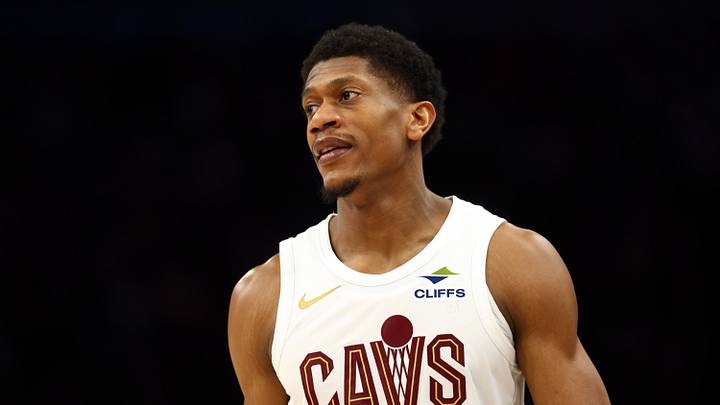
Former Cleveland Cavaliers wing De'Andre Hunter will begin his first full season with the Sacramento Kings in just over two months, but Cleveland is looking for a player just like him all over again.
The Cavaliers have two exciting young wings in their sights this summer. Both Peyton Watson and Jonathan Kuminga are prime candidates for Cleveland, and the latest rumors confirm the Cavs are still in pursuit. Following a salary dump Dennis Schröder trade, the Cavaliers have $6.8 million more cap space below the first apron to chase either forward and retain James Harden.
On the afternoon of August 14, the Cavaliers traded veteran point guard Dennis Schröder just months after acquiring him at last year's trade deadline. Cleveland sent Schröder and cash to the Charlotte Hornets in exchange for Tre Mann. The deal immediately looked like a precursor to the Cavaliers finally landing one of their prime trade targets, but the deal also showcases a horrowing mistake the Cavs made.
The aforementioned point guard joined Cleveland from Sacramento when the Cavaliers traded De'Andre Hunter to the Kings for Schröder and Keon Ellis in a three-team transaction. Hunter had only played for the Cavaliers for a year, having joined the franchise the prior trade deadline.
In the midst of a strenuous regular season, the struggling Cavaliers made two major trades at the deadline. Hunter was out, and so was Darius Garland. In came Schröder, Ellis, and Harden. Currently, none of these three are on the Cavaliers roster; however, Harden is still nearly guaranteed to re-sign on a multi-year deal. Ellis left for the Brooklyn Nets on a multi-year deal, leaving Schröder the final piece to depart.
Cleveland's Hunter saga has been nothing but bad
In February 2025, Hunter joined the Cavaliers from the Atlanta Hawks. Cleveland traded Caris LeVert, Georges Niang, three future second-round picks and two future first-round swaps for the 6-foot-8 forward.
With Schröder gone, the Cavaliers have virtually no traces of Hunter still in place.
OUT: Caris LeVert, Georges Niang, three second-round picks, two first-round swaps, De'Andre Hunter, Dennis Schröder, Keon Ellis, cash considerations.
IN: Tre Mann
If the Cavaliers hope to get equal value in return, Mann has a lot of All-Star appearances to aspire towards.
In the 2025-26 season, trading Hunter for Ellis seemed like a sneakily perfect win for the Cavaliers. The young wing was a pesky defender and looked just as good as Hunter as a catch-and-shoot threat. Despite being four inches shorter and noticeably slimmer, Ellis' arrival was welcome. Hunter had seen a significant dip in his production that season, and a desperate Cavs team seemingly found a hidden gem in Ellis.
With so many players gone and nothing left to show for it, the entire De'Andre Hunter saga in Cleveland only stands to exemplify the roster mismanagement the Cavaliers front office has struggled to contain.
De'Andre Hunter was never the problem
At the time of Hunter's arrival in Cleveland, he was nearly a career 40-percent three-point shooter and a leading candidate for that season's Sixth Man of the Year award. In 27 games with Cleveland that regular season, Hunter posted 14.3 points and 4.2 rebounds per game while shooting 42.6 percent from deep. The Cavaliers finally found an elite three-point shooting wing for the starting lineup, and his defense was steadily improving as he used his size and athleticism to lock down assignments.
While an imperfect defender, Hunter showed immense promise for the Cavaliers. His playoff contributions dipped slightly as he averaged 11 points per game, shooting 46.2 percent on lower volume from deep. His impact was still noticeable, and he with an offseason to prepare, his potential as a positive player was high.
When next season came, Hunter looked much worse. He still averaged 14 points per game, but his shooting dropped to 30.8 percent from deep. His defense was subpar, and while that side had never been his strength, he showed serious regression. Though it was easy to blame Hunter, the resolution of this chapter in Cavaliers history only shows he was the scapegoat for a larger problem continually ignored.
That season exemplified the Cavaliers' shallow frontcourt depth, the persistent flaw in roster construction that had gone unchecked. Hunter's role fluctuated nearly every game, placing him out of position and rarely with the same composition around him. Early season injuries sidelined Evan Mobley, Jarrett Allen and Dean Wade, forcing Hunter to become a Swiss Army Knife in ways he couldn't fulfill.
The Cavaliers' wealth of undersized wings and guards left Hunter as the only viable candidate to fill any of these roles, but when the team got closer to full strength, Hunter's poor performance left him alternating from a bench player to a starter. Without any consistency in his day-to-day expectations, the Cavaliers ultimately failed Hunter and transformed him into a trade deadline scapegoat.
This summer, the Cleveland Cavaliers are looking for a player eerily similar in archetype and style to Hunter. Watson is an up-and-coming athletic forward who can play off ball, shoot off the catch and play versatile defense. Kuminga is equally an athletic, built forward who has showcased flashes of great shooting. Although either player is arguably more valuable than Hunter in a vacuum, the cost to acquire and subsequently ditch Hunter only serves to make the acquisition of his potential replacements that much more costly.
 Add us as a preferred source on Google