

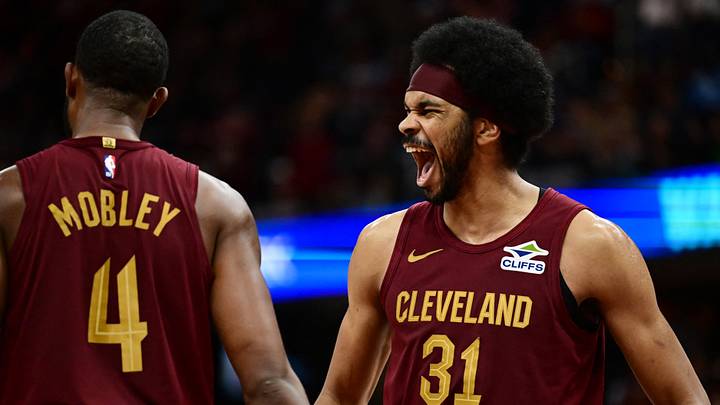
The Cleveland Cavaliers have a Defensive Player of the Year in Evan Mobley and one of the league's more established traditional centers in Jarrett Allen. With that combination protecting the paint, rebounding should be one of Cleveland's strengths.
So how did the Minnesota Timberwolves manage to grab 17 offensive rebounds and score 23 second-chance points against them? It's a question the Cavaliers need to answer before their struggles on the glass become a much bigger problem.
Cleveland escaped with a 127-125 overtime victory against Minnesota, but the final score doesn't tell the entire story. The Timberwolves repeatedly extended possessions after missed shots, forcing the Cavaliers to defend the same trip down the floor multiple times. For a team with two accomplished defensive big men, that's a frustrating problem to have.
More concerning is that it exposes a weakness that can't be solved by relying on Mobley and Allen alone.
One Minnesota possession exposed Cleveland's rebounding problem
The most telling sequence came with 7:54 remaining in the fourth quarter. Anthony Edwards missed a three-pointer, giving Cleveland an opportunity to secure the rebound and head the other way.
Instead, Rudy Gobert grabbed the offensive board.
Edwards missed another shot, and Gobert collected another offensive rebound. Minnesota continued attacking until Terrence Shannon Jr. eventually converted a three-pointer. The Cavaliers had forced three missed shots on a single possession and still surrendered three points. That sequence captures the problem better than any individual rebounding statistic.
Cleveland was doing enough defensively to make Minnesota miss. What it couldn't do was finish the possession. It's difficult to build a reliable defense when forcing a missed shot doesn't guarantee an opportunity to take the ball back.
Gobert deserves credit for his work on the offensive glass. He's one of the NBA's most accomplished rebounders, and Minnesota's size presented a legitimate challenge. That being said, the Cavaliers still have enough talent in their own frontcourt to expect a better result. They shouldn't need three or four defensive stops to get the basketball back.
Evan Mobley and Jarrett Allen can't rebound for everyone
The presence of Mobley and Allen makes Cleveland's rebounding struggles surprising, but it also highlights a misunderstanding about how defensive rebounding works. Protecting the rim and controlling the glass are related responsibilities. They aren't identical.
Mobley is an exceptional help defender because of his ability to rotate, challenge shots and cover ground that most big men simply cannot. His defensive instincts allow Cleveland to pressure opponents without leaving the basket completely unprotected. That same aggressiveness can also pull him away from ideal rebounding position.
When Mobley steps across the lane to contest a drive, somebody else has to account for the offensive player he leaves behind. Otherwise, Cleveland can force a difficult shot only to watch an opponent collect the miss.
Allen faces a similar challenge when he's drawn into a defensive rotation or forced to challenge a shot away from his original assignment. Neither player can contest every attempt, box out every opponent and collect every rebound. That's where Cleveland's guards and wings become essential.
Defensive rebounding requires all five players to identify their assignments, establish position and prevent opponents from getting a running start toward the basket. When a perimeter defender watches the shot instead of locating his man, even a frontcourt featuring Mobley and Allen can become vulnerable. The Cavaliers have the individual talent to protect the paint. They need the collective discipline to finish the job.
Kenny Atkinson's smaller lineups create another challenge
Cleveland's rebounding concerns also become more complicated when Kenny Atkinson adjusts his closing lineup. Against Minnesota, the Cavaliers finished with James Harden, Donovan Mitchell, Sam Merrill, Peyton Watson and Mobley. That combination offers several advantages.
Harden and Mitchell provide shot creation, Merrill stretches defenses with his perimeter shooting, and Watson gives Cleveland an athletic defender capable of challenging opposing stars. Mobley anchors the defense while offering more offensive flexibility as the lone big man. The lineup makes sense when Cleveland needs spacing, defensive versatility and reliable offensive options. It also comes with a trade-off.
With Allen on the bench, Mobley becomes Cleveland's primary interior presence. That means the Cavaliers must receive consistent rebounding contributions from players who are smaller than the opponents they're trying to keep off the glass.
Watson's defensive performance against Minnesota demonstrated the upside of this approach. His game-saving block on Edwards helped force overtime and showed why Atkinson trusts his athleticism in critical moments.
But spectacular defensive plays don't eliminate the need to secure rebounds. A lineup can have the right combination of shooting and defensive playmaking while still struggling to control the glass. Atkinson has to find a way to preserve the benefits of those smaller combinations without allowing opponents to generate extra possessions. That responsibility extends beyond whichever center happens to be on the floor.
Cleveland's defensive talent means little if opponents keep getting second chances
The Cavaliers have enough offensive firepower to survive mistakes during the regular season. Mitchell and Harden can create scoring opportunities when Cleveland needs a basket, while Mobley's expanding offensive game gives Atkinson another weapon. That talent helped the Cavaliers overcome Minnesota's physicality. It won't always be enough against the teams Cleveland expects to face in the postseason.
Playoff basketball places greater importance on individual possessions. Opponents study defensive weaknesses, attack unfavorable matchups and punish teams that fail to execute the fundamentals. Giving up 17 offensive rebounds and 23 second-chance points is a dangerous habit for a team trying to compete for a championship.
The solution isn't necessarily playing Mobley and Allen together for every important minute. Cleveland needs the flexibility to adjust its lineups depending on the matchup. The solution is making defensive rebounding a responsibility shared by everyone on the floor. Mobley can erase a driving lane. Allen can challenge a shot at the rim. Watson can deliver a spectacular block against one of the league's best scorers.
None of those plays finishes the defensive possession until somebody secures the basketball. Cleveland has the talent to make opponents miss. Now it needs to show it can keep them from getting another chance.
 Add us as a preferred source on Google