

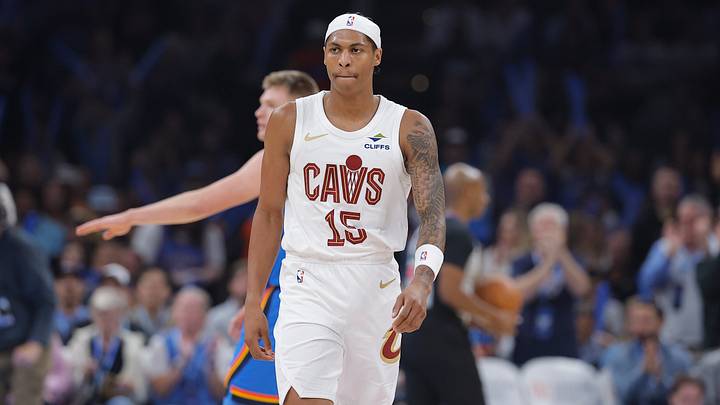
When the current iteration of Cleveland Cavaliers basketball came to fruition back in 2022-23, there was no doubt what that team hung its hat on: defense.
That season, Cleveland ranked first in the league in defensive rating throughout the regular season at an impressive 109.9. Evan Mobley and Jarrett Allen had become utterly dominant on the interior, while the likes of Isaac Okoro and Dean Wade, among others, made life miserable for opponents on the perimeter.
Since then, however, the Cavaliers’ defense has slowly deteriorated year after year. The next three seasons, Cleveland’s defensive rating has dropped to seventh, eighth and then 15th in the league, respectively, before falling even further to 22nd this year.
There are a multitude of reasons for the gradual slide into the below-average state that the defense resides in today, but the blame should be focused on the front office’s lack of replacing key defensive talent.
Okoro and Wade’s absences are missed
First, let’s just put it out there that Okoro was far from a perfect player. In fact, he might not even be a serviceable NBA player. But make no mistake: there is a direct correlation between Cleveland’s defensive performance taking a downturn and the organization shipping Okoro away back in the summer of 2025.
In 2024-25, Okoro’s final season with the Cavaliers, the team was +5.5 better in terms of net rating when Okoro was on the floor versus when he was off.
Lonzo Ball, the player the Cavaliers directly traded Okoro for, did not have the same type of on-off impact in 2025-26, as Okoro did the previous year. In fact, the Cavaliers were -4.7 worse when Ball was on the floor versus when he was off last season.
Then, this past summer, Wade, who was a free agent, signed a four-year deal worth over $38 million with the Philadelphia 76ers. Once again, the Cavaliers tried to replace him by acquiring Peyton Watson, but that hasn’t exactly gone to plan either.
This season, the Cavaliers have a whopping -16.8 worse net rating when Watson is on the floor versus when he’s off and the young wing has struggled on both ends. Plus, it should be mentioned that to get Watson, Cleveland had to deal away Max Strus, who actually had been one of the more positive defenders over the years.
The Cavaliers missed a golden opportunity in the draft
So, with money being somewhat tight, the perfect way for the team to address their growing defensive issues on the perimeter would be a selection on that front in the 2026 NBA Draft.
Cleveland owned the 29th pick, but traded it to Sacramento for the 34th pick and a 2032 second rounder. From there, as we all know, the Cavaliers then selected Meleek Thomas 34th.
To be clear, Meleek Thomas, at least at this point, shouldn’t be considered a bad player. Less than a month into his NBA career, he’s shown real flashes as a high level scoring guard off the bench. The problem is that for this roster, his presence is a luxury rather than a need.
Right now, the team has a plethora of small to mid-sized guards. Donovan Mitchell and James Harden play the most minutes, obviously, but off the bench Sam Merrill, Tyrese Proctor and even Craig Porter Jr. see real time to go along with Thomas.
Before the year, it was unclear how much of a role Proctor would have, especially with the selection of Thomas, but at this point Kenny Atkinson is making a serious effort to get him minutes and even start him in some games. Because of that, Thomas’s place in the group is even more of a head-scratcher.
Looking back to what Cleveland could have had, the Kings ended up taking Alex Karaban with that 29th pick. To be fair, Karaban hasn’t had hardly any impact whatsoever on perhaps the league’s worst roster. But, he’s exactly what the Cavaliers need.
Cleveland has Mario Hezonja, who has been a solid frontcourt player, but is almost more of a big than a true wing at this point in his career, as well as Jaylon Tyson, who has battled injuries throughout the first month. Another bigger wing such as Karaban would be the perfect piece to slide into the rotation in spots, at least attempting to fill the Wade-sized hole in this roster.
Plus, like Wade, perhaps in a couple of years Karaban would develop into a reliable wing for the next decade, which given his experience at UConn, would surprise no one.
Karaban isn’t the only direction the team could have gone with that 29th pick either. Koa Peat, another big-bodied wing was taken 30th; Trevon Brazile, who is already playing valuable minutes for the Denver Nuggets, went 35th; and Emanuel Sharp, another Sacramento wing, went 45th, just to name a few.
When it’s all said and done, the Cavaliers might be thrilled that they picked Thomas. That’s a real possibility and there’s no denying that, but for a team that is build to win a championship now, they didn’t address a key need that could continue to plague them for months to come.
 Add us as a preferred source on Google