

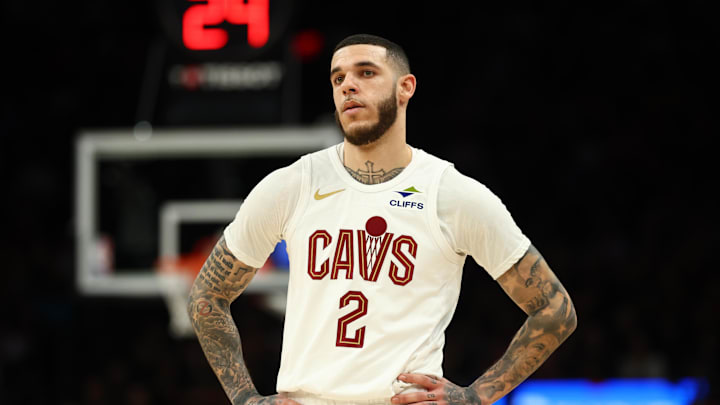
The Cleveland Cavaliers traded for Lonzo Ball before the season, and he was a disaster in Cleveland and has already been traded away. Even with his failure, however, the struggles of Isaac Okoro in Chicago make the Cavaliers still clear winners of the Lonzo trade.
Things never clicked for Lonzo in Cleveland, which remains one of the bitter layers of this season. He should have been the perfect fit as a do-it-all role player gluing together lineups next to both Darius Garland and Donovan Mitchell. He has size, he shoots well off the catch, he defends, and his passing is excellent.
Lonzo Ball struggled in Cleveland
Unfortunately, Ball just wasn't up to it with the Cavaliers. His shooting fell off precipitously; he hit only 27.2 percent of his 3-pointers and a frigid 30.1 percent from the field overall. His turned the ball over, his defense was less impactful, and in essentially every way, he was a negative for Cleveland when he stepped onto the court.
The Cavs attached a pair of second-round picks to Ball and dumped him on the Utah Jazz at the trade deadline. The Jazz promptly waived him, and he hasn't found his way back to an NBA team this season. Hopefully, he is able to rehabillitate his game and find a new home this summer.
Looking at this trade through the lens of Lonzo Ball, it was a colossal failure for the Cavaliers. They traded for a player who wasn't worth the minutes the Cavs gave him, and they had to pay another team to take on his $10 million salary. They lost that trade, right?
Perhaps not.
Isaac Okoro has been terrible in Chicago
The original trade to bring in Lonzo Ball sent out Isaac Okoro, a longtime Cleveland wing whom they once drafted No. 5 overall. The Chicago Bulls liked Okoro enough to trade for him straight up, so it didn't cost the Cavaliers anything else to bring in Ball.
Much like everyone on the Chicago Bulls other than Matas Buzelis, Okoro had a rough season. His minutes and shots went up, but he didn't make the most of them, shooting just 33.8 percent from deep and averaging a pedestrian 9.2 points per game. Okoro's steal rate went down, his turnover percentage went up, and he rated as a negative player on both ends of the court.
Neither Okoro nor Ball appear to be rotation NBA players, at least not given what they showed this season. The difference is that Ball is on an expiring contract, while Okoro is under contract for $11.8 million next season.
Cleveland came out ahead
If the Cavaliers had kept Okoro, not only would they have been unable to play him in their rotation this year, but they wouldn't have been able to move on from him so easily at the trade deadline. They either would have had to attach more draft capital - draft capital they don't really have - or they would be stuck paying him even now.
The Lonzo Ball trade didn't give the Cavaliers what they hoped it would, but it did position them to move on if the trade didn't work. They did that, and are in a better spot now than if they had hung onto Isaac Okoro.
It's hard to say it, but the Cleveland Cavaliers won the Lonzo Ball trade.
 Add us as a preferred source on Google