

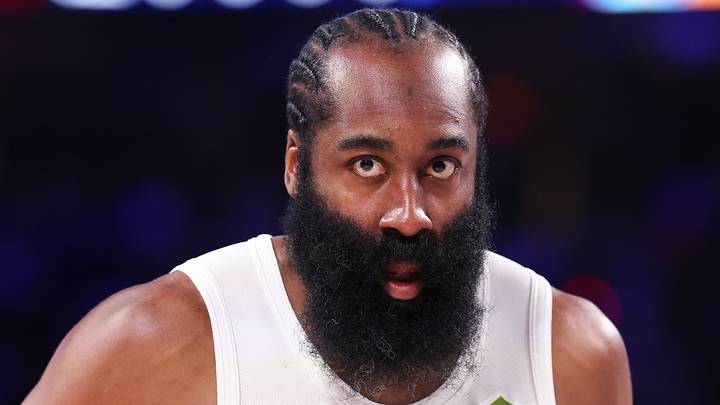
To be honest, a lot of us are shocked, and also not that surprised at all. And that's a sad state to be in when you're rooting for your team to get over the hump and win a championship. To see #CavsDoingCavsThings as a running joke all over social media is not just disheartening; it delivers the kind of blow that makes it hard for fans to get behind the squad, at least in the immediate aftermath when we're still salty about such a massive choke job.
Of course, as with most things in life, everyone is looking for someone to blame. Where's the grit? Where's the resilience? Why in the world did the Cavs look like a completely different team in the second half? And for goodness sake, why can't James Harden guard a light post at this point?
The Cleveland Cavaliers didn't just blow a huge lead against the Philadelphia 76ers. They exposed a problem that could follow them all season. James Harden finished with more turnovers than assists, posted an ugly plus-minus and struggled to keep Cleveland's offense functioning as Philadelphia mounted its comeback.
Yet when the Cavaliers needed someone to rescue them late, Harden remained heavily involved in their offense. That's a difficult decision to defend when Donovan Mitchell had spent much of the night demonstrating why he is Cleveland's first option.
James Harden's opening-night struggles should concern Cleveland
Harden finished with 16 points, 5 assists and 6 turnovers in Cleveland's 114-106 defeat. His minus-17 rating was the second-worst on the team, and the Cavaliers were outscored by 17 points during his 33 minutes. Plus-minus doesn't establish individual responsibility for a defeat, but Harden's turnovers provide a more direct indication of his struggles.
For a player whose greatest remaining strength is supposed to be his ability to organize an offense, recording more turnovers than assists is especially concerning. When? When is Harden going to answer the call and use his veteran status to steady the ship and be of some assistance to Donovan Mitchell? Not in the general sense, but when it matters most -- in situations where we're in the trenches, and they have to go get the game.
Donovan also wasn't great when it came to taking care of the ball. He had 5 turnovers himself, but at least he was an efficient scorer who was offensively consistent. Cleveland led by 24 at halftime before scoring just 37 points over the final two quarters. The Cavaliers needed someone capable of controlling possessions, recognizing Philadelphia's defensive adjustments and preventing the offense from deteriorating. Hmmm, I wonder who that was supposed to be.
Harden was acquired partly because of his experience in those situations. Instead, Cleveland repeatedly struggled to generate quality opportunities as its advantage disappeared. One performance doesn't erase Harden's considerable value, but Thursday exposed the danger of depending on him to provide stability when he isn't playing well.
Why was Harden still Cleveland's go-to option down the stretch?
Great question. That's what we're all wondering, too.
Kenny Atkinson's late-game offensive decisions deserve scrutiny because Cleveland had another obvious option. Mitchell finished with 32 points and 10 rebounds while shooting 11-of-19 from the field. He was Cleveland's most effective offensive player for much of the evening, consistently demonstrating his ability to create scoring opportunities against Philadelphia. That should have earned him greater control when the game was slipping and morale was all but nonexistent.
Harden remained central to Cleveland's late-game offense despite struggling with turnovers and decision-making. He contributed points down the stretch, but his overall performance hardly justified treating him as the preferred initiator. The Cavaliers needed more possessions built around Mitchell attacking Philadelphia's defense, with Harden operating as a secondary facilitator rather than controlling the action by default.
Evan Mobley also should've been more involved in the action. He scored 18 points on 7-of-13 shooting, yet Cleveland's offensive approach didn't consistently capitalize on his ability to attack mismatches and create opportunities closer to the basket.
Atkinson has to establish a hierarchy that reflects who is actually producing. Against Philadelphia, Cleveland needed more Mitchell and Mobley, not additional dependence on an ineffective Harden.
LeBron, Curry and Durant may have distorted expectations for aging superstars
Harden turned 37 in August, and Cleveland needs to acknowledge what that means for a player who has carried enormous offensive responsibilities throughout his career. He remains an accomplished passer and capable scorer, but the explosiveness that once made him nearly impossible to contain has diminished. Creating separation, attacking the basket and consistently generating efficient offense become more difficult as athleticism declines.
Atkinson needs to recognize when Harden's involvement is helping Cleveland and when the offense would benefit from a different approach. Mobley represents Cleveland's long-term future and provides the two-way versatility necessary to compete against elite opponents. His offensive development should be a priority, particularly when opposing defenses concentrate on the backcourt.
LeBron James, Stephen Curry and Kevin Durant have complicated how fans evaluate aging superstars.
Their extraordinary longevity has made elite production deep into a player's 30s seem almost routine. In reality, those three represent historical exceptions rather than reasonable expectations for every former MVP. Harden's struggles Thursday don't prove that his decline has accelerated or that he can no longer contribute at a high level.
They do reinforce that Cleveland cannot assume Harden will consistently reproduce the offensive dominance that defined his years in Houston. The Cavaliers need to evaluate the player he is today, rather than continue building their late-game offense around the player he used to be.
 Add us as a preferred source on Google