

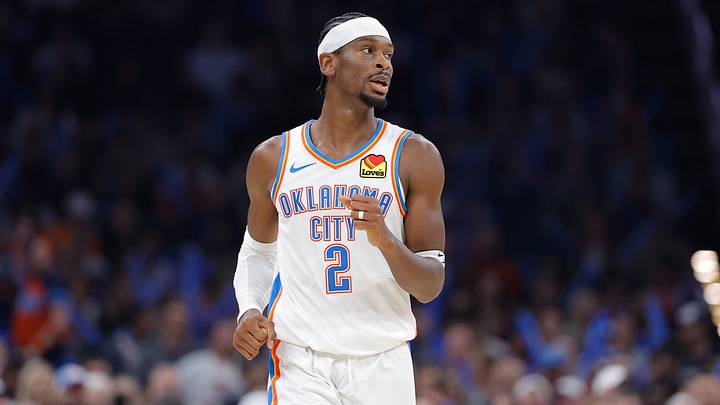
The Cleveland Cavaliers have enough problems of their own to worry about, but Monday's matchup against the Oklahoma City Thunder presents an interesting opportunity. Shai Gilgeous-Alexander, one of the NBA's most difficult players to defend, hasn't been scoring at his usual rate.
That doesn't mean he's suddenly become an average offensive player. Far from it. However, the numbers suggest something has changed, and Cleveland should be paying attention.
Through six games, Gilgeous-Alexander is averaging 26 points per game, down from 31.1 last season. His field goal percentage has also fallen from 55.3 percent to 46.5 percent. More interestingly, he's getting to the free-throw line far less often.
The Thunder are already missing several important players, including Jalen Williams and Chet Holmgren. That puts even more responsibility on Gilgeous-Alexander to generate offense, which makes his early-season scoring decline worth watching.
For the Cavaliers, this could be an opportunity to make an already difficult situation even worse for Oklahoma City.
Shai Gilgeous-Alexander's free-throw decline is impossible to ignore
Gilgeous-Alexander averaged nine free-throw attempts per game last season. Through his first six appearances this year, that number has dropped to just 4.7. That's a reduction of more than four attempts per game for a player whose ability to draw fouls has been an important part of his scoring success.
Last season, he converted roughly 7.9 free throws per game, accounting for more than a quarter of his 31.1-point scoring average. This year, he's making four free throws per game, which accounts for about 15 percent of his offense.
That's a meaningful difference, especially for a player who has built his reputation on getting into the paint, creating contact and making defenders uncomfortable. The timing is also interesting because the NBA entered the 2026-27 season with a renewed emphasis on offensive push-offs and exaggerated movements designed to draw fouls.
League officials have specifically addressed offensive players using their off arms to create separation, while also emphasizing the distinction between legitimate contact and movements intended to manufacture foul calls.
It's too early to conclude that those officiating priorities are directly responsible for Gilgeous-Alexander's declining free-throw attempts. His field goal efficiency has also dropped, and six games represent a small sample. However, the possibility deserves consideration.
When a player who routinely generates points at the foul line suddenly gets fewer opportunities, the impact on his scoring average can be substantial.
Cavaliers must make Gilgeous-Alexander earn his points
Cleveland shouldn't mistake Gilgeous-Alexander's lower scoring average for an invitation to relax defensively. He's already scored 34 points against the Clippers and 32 against San Antonio this season. His ability to create shots off the dribble remains dangerous, regardless of how frequently he's reaching the foul line.
The Cavaliers need to be disciplined about how they defend him. That means avoiding unnecessary reaches, staying in front of him whenever possible and refusing to bail him out with fouls when he's forced into difficult shots.
The league's emphasis on offensive contact could also benefit defenders who maintain legal positioning rather than reacting to every movement from the ball handler.
Cleveland doesn't need to shut Gilgeous-Alexander down completely. That's an unrealistic expectation against a player of his caliber. What the Cavaliers can do is make him work for his production without giving him a steady supply of easy points.
If Gilgeous-Alexander finishes with 26 points because he consistently beats defenders and makes contested shots, Cleveland can live with some of that. Allowing him to reach 35 or 40 because of repeated defensive mistakes would be another matter.
Oklahoma City's injuries make containing Shai even more important
The Thunder's depleted rotation adds another dimension to this matchup. With Williams unavailable, Oklahoma City is missing one of its most important secondary scorers. Holmgren's absence also removes another player capable of creating offense and stretching Cleveland's interior defense.
That leaves Gilgeous-Alexander carrying an enormous share of the offensive responsibility. Cleveland should recognize the opportunity. The Cavaliers have Donovan Mitchell, James Harden, Evan Mobley and Jarrett Allen available, giving them considerably more established offensive options than the shorthanded Thunder.
If Cleveland can limit Gilgeous-Alexander's trips to the foul line while forcing Oklahoma City's remaining players to create their own offense, the Thunder could struggle to keep pace.
Of course, the Cavaliers must avoid assuming that Gilgeous-Alexander's early-season numbers will continue indefinitely. Great scorers adjust, and he's more than capable of producing a breakout performance against Cleveland.
That's precisely why the Cavaliers need to approach the matchup with a defensive plan built around discipline rather than hoping his struggles continue. The NBA's officiating emphasis may be changing how certain offensive players generate points, and Gilgeous-Alexander's numbers suggest he's experiencing a noticeable adjustment.
Cleveland now has an opportunity to find out whether that trend can work in its favor. With Oklahoma City already missing so much talent, allowing Gilgeous-Alexander to dominate the game would be an especially frustrating outcome. The Cavaliers should make him earn every point.
 Add us as a preferred source on Google