

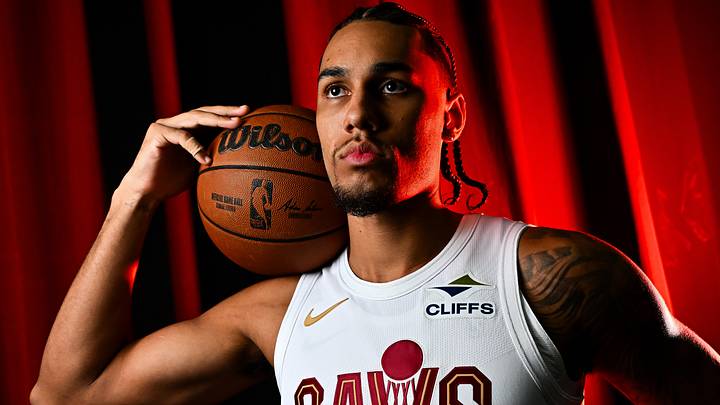
The Cleveland Cavaliers have a problem most NBA teams would love to have. They've got too much talent and not enough minutes.
And with Donovan Mitchell and James Harden leading a team that's supposed to compete for a championship right now, head coach Kenny Atkinson doesn't exactly have the luxury of treating the regular season like a developmental program.
That doesn't mean that another loss this season calls for a gap year to rebuild or anything. It also doesn't mean that they don't need to just… take a gap year to rebuild and call this Harden-Mitchell combo a failed experiment. It happens.
Would that really be that bad, though? Cleveland has some genuinely intriguing young players, and at least one of them might already be making a case that he's too good to sit.
Jaylon Tyson is making Cleveland's decisions harder
Jaylon Tyson scored 14 points in just 16 first-half minutes against the Boston Celtics in Cleveland's preseason opener. Sure, it's preseason. Nobody's handing out awards in October. But performances like that create questions.
Tyson is no longer just a promising young player that the Cavaliers can afford to bring along slowly. He's someone who could contribute to a winning team right now. And if he keeps producing, whose minutes is he taking? That's the part that's up in the air.
Atkinson has veterans he trusts, established rotations to consider, and two star guards who will command significant playing time. Finding opportunities for Tyson means making decisions that could leave someone else watching from the bench.
That's a good problem to have until it isn't.
Cleveland's younger players aren't all on the same timetable
Now consider Meleek Thomas.
The rookie brings offensive upside, but expecting him to become a dependable contributor on a championship contender immediately would be asking quite a bit.
Thomas needs opportunities to make mistakes, learn defensive assignments, and adjust to the NBA's physicality. And he already has some ideas about how he can earn meaningful rotation minutes as a rookie. But knowing what it takes to get on the court and actually getting those opportunities are two different things, especially on a team chasing a championship.
Craig Porter Jr. presents another dilemma.
His 10 assists against Boston offered a reminder of his ability to organize an offense. But with Harden and Mitchell handling so much of Cleveland's playmaking, how often will Porter get the chance to demonstrate what he can do?
Then there's Khalifa Diop, whose path to meaningful minutes is complicated by Cleveland's established front court. These players have different needs, strengths, and developmental timelines.
Yet they're all competing against the same reality: Cleveland wants to win now.
The Cavaliers can't afford to forget about tomorrow
This situation is particularly interesting because, regardless of whether or not they want to win now, Harden is almost 40. No matter how much fans want to bash him, he's not prime Harden, and he's not LeBron James. His 40 years old is not going to be Bron’s 40 years old. So, the team has to capitalize now.
At the same time, Cleveland will eventually need its younger players to become more than just interesting names on the depth chart. And that doesn't happen simply because a team believes in their potential.
Players need meaningful minutes. They need responsibilities. They need opportunities to struggle through the occasional bad performance without wondering whether one mistake will cost them their place in the rotation.
Of course, nobody's suggesting Atkinson should sacrifice wins just to develop a rookie. But what's going to happen when developing a young player and winning a basketball game starts pulling Cleveland in opposite directions?
That's something the Cavs are going to have to figure out because Tyson might already be ready to help. Thomas could become an important piece down the road, and Porter and Diop still have something to prove.
Cleveland has the veterans to chase a championship today and the young talent to remain competitive tomorrow.
The challenge is making sure its pursuit of one doesn't come at the expense of the other.
 Add us as a preferred source on Google