

The Cleveland Cavaliers have invested heavily in assembling a roster capable of competing for an NBA championship, but their financial commitments have created a challenge that could become troublesome as the season progresses. With approximately $209 million committed to player salaries, Cleveland has limited flexibility to address weaknesses that emerge before the trade deadline.
One salary-cap tracker places the Cavaliers approximately $45,000 below their first-apron hard cap, leaving Koby Altman with little room to absorb additional salary under that restriction. The precise margin requires confirmation against the latest team transactions, but Cleveland's substantial payroll illustrates the financial constraints accompanying its championship ambitions.
Those limitations are especially concerning for a team that has already displayed inconsistent execution. Cleveland needed a significant second-half comeback to defeat Washington before surrendering a 15-point lead in its loss to Atlanta.
Although two October performances don't mean a whole lot, they provide reasons to think about whether the current roster has the balance necessary to compete with the Eastern Conference's strongest opponents.
Cleveland's financial commitments complicate potential roster changes
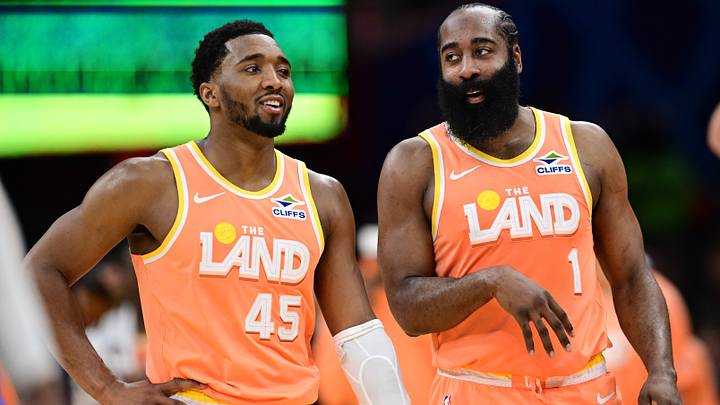
The Cavaliers have committed substantial resources to Donovan Mitchell and Evan Mobley, while James Harden provides another established offensive creator. Jarrett Allen remains an important part of Cleveland's frontcourt, giving the team a core capable of competing against talented opponents.
That approach reflects an understandable organizational priority. Cleveland has an opportunity to compete during Mitchell's prime while Mobley continues developing, and ownership has demonstrated a willingness to support that opportunity financially.
However, the NBA's salary-cap system places restrictions on certain transactions involving teams operating above designated payroll thresholds. Those limitations can affect trade structures, salary aggregation and the mechanisms available to acquire additional players, depending on a team's position relative to the applicable apron.
Cleveland's reported proximity to its hard cap further complicates transactions that would increase its payroll. Even if the front office identifies a desirable addition, Altman must determine whether the deal satisfies the league's financial rules and whether the Cavaliers have suitable assets to complete it.
Cleveland's current roster must provide most of the answers
The resulting challenge is that Cleveland's current roster must provide most of the solutions to its shortcomings. The Cavaliers cannot approach the trade deadline assuming that an outside acquisition will be available to address every deficiency.
The Cavaliers' early performances have raised questions about their ability to maintain defensive consistency and generate dependable offense throughout games.
Against Washington, Cleveland surrendered 69 first-half points before recovering to secure a 121-111 victory. The following night, the Cavaliers lost 114-111 to Atlanta after allowing the Hawks to erase an early advantage.
Those results should not prompt an immediate roster overhaul, particularly with the season barely underway. They do, however, demonstrate why championship contenders benefit from maintaining options as their needs become clearer.
Cleveland cannot afford another postseason built around unresolved weaknesses
If Cleveland determines that it needs another perimeter defender, a more reliable secondary scorer or additional versatility in its rotation, the front office will have to evaluate those possibilities within a restrictive financial environment.
That could force Altman to consider transactions involving existing contributors rather than simply adding another player. Such decisions introduce additional risks because addressing one weakness can create another elsewhere on the roster.
The Cavaliers have already invested in a specific combination of established stars, developing talent and complementary players. Their ability to improve may depend more heavily on internal development and coaching adjustments than on acquiring reinforcements.
If the current roster develops into a genuine championship contender, the organization's substantial investment will be justified. If familiar problems persist into the postseason, Cleveland could face another disappointing finish without an obvious or affordable path toward improvement.
Altman's decision to commit heavily to this roster has narrowed his alternatives, making the performance of the players already in Cleveland more consequential than ever.
 Add us as a preferred source on Google