

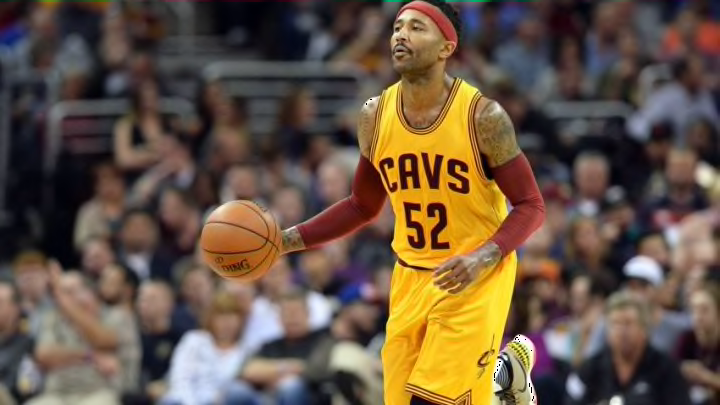
Mo Williams returned to the Cleveland Cavaliers in the off-season to much fanfare but has he been a success or failure for the Cavs?
To gain the full scope on whether Williams has been a positive for the Cavaliers this season, expectations need to be remembered.
After their finals defeat to the Golden State Warriors, one of the major issues for the Cavs was a lack of playmakers. Due to the injuries suffered by Kyrie Irving and Kevin Love, Cleveland had LeBron James and that’s about it. The shortcomings of the likes of Matthew Dellavedova, Iman Shumpert and J.R. Smith were exposed and it formed a pressing need on this Cavs team.
This is where the Williams signing made so much sense. Despite entering the later stages of his career, Williams was by no means washed-up. In 2014/15, where he played with both the Minnesota Timberwolves and Charlotte Hornets, Williams averaged 14.2 points, 6.2 assists and 2.6 rebounds per game, while shooting 39.7 percent from the field and 34.2 percent from beyond the three-point line.
Those are numbers that represent exactly what the Cavs were searching for- a fairly effective scorer and playmaker off the bench, especially when the big three weren’t on the court. The fact that Williams had a pre-existing relationship with James and the Cavalier organization was simply an added bonus.
With the playoffs just a week away though, Williams is limping into the post-season, no fault of his own. Williams’ bum knees have plagued him throughout the second half of the season and there is simply nothing he can do about that.
Forget the injuries though. Williams has fallen out of the rotation and he has no one to blame but himself for that. While Williams has provided some nice moments for the Cavs this season, overall, his production has fallen short of what the Cavaliers were hoping for.
“Being able to make shots, he made some big shots,” Tyronn Lue said when asked about what the Cavs have gotten from Williams this season, via cavs.com. “Playing with a pace, playing with a tempo and he was guarding. He did a good job of guarding the basketball.”
Let’s take this quote from Lue and break down Williams season into three distinct areas- scoring, offensive impact and defense.
Scoring
Williams has always been known as a scorer during his career and this was one of the main reasons Cleveland wanted him. On a team lacking scoring options off the pine, Williams seemed to fit the team perfectly as a bench scorer.
It hasn’t turned out as planned.
Yes, Williams has averaged 8.2 points per game, a solid number, but it is inflated due to Irving’s absence earlier in the season. In 14 games as a starter this season, Williams averaged 14.5 points, while shooting 49.1 percent from the floor and 36.7 percent from beyond the three-point line.
These are excellent numbers all things considered. The Cavs were able to stay afloat and atop of the Eastern Conference during Irving’s injury thanks to an uptick in production in the scoring department from Williams.
This part of Williams’ season gets a pass. One of the reasons Williams was brought in was to bolster the Cavs depth if an injury occurred and he was adequately able to provide the insurance the Cavaliers needed.
However, in Williams expected role, a bench scorer, he has failed. In 27 games as a reverse, Williams has averaged just 5.0 points per game, shooting 37.8 percent from the floor and 33.3 percent from downtown.
This minimal impact provided from Williams has been surprising, especially considering his hot shooting start to the season. It also makes it very tough to give Williams a clear mark in the scoring department this season. For one, he did what he needed to do when Irving was out of the line-up but on the other hand, Williams couldn’t give the Cavs what they needed from him off the bench.
All in all, it is almost impossible to say Williams was successful in this area. Yes, he stepped up when needed but ultimately, Cleveland needed Williams to fulfill a very particular role and he failed to give the Cavs what they craved.
Offensive impact
There is a distinction to be made between offensive impact and scoring.
In Lue’s above quote, he mentions how Williams has been able to push the pace and get the Cavs playing at a faster tempo when he is on the floor. By the eye test, this is true. It seems as if Williams was willing to push the ball up the floor and get the Cavaliers into early offense.
Numbers wise, the difference is unnoticeable. With Williams on the court, Cleveland has a pace of 95.63 compared to 95.44 when he is on the bench.
There is nothing we can really take from this. In fact, Cleveland has been near the bottom of the league in pace all season long, despite Lue’s desire to increase the tempo of the Cavaliers offense. Now, a better pace doesn’t always mean more possessions. Lue has stated he wants a quicker pace so the Cavs can have a greater quality of possessions, rather than a greater quantity. So when asking the question if Williams improved the Cavs pace, it really is up to the eye test, which creates no clear answer.
However, what we can determine is that Cleveland has been a much better offensive unit with Williams off the floor. The Cavs score 110.6 points per 100 possessions with Williams off the court, compared to just 98.0 with him on the floor.
This paints a clear picture that Cleveland were actually a worse offensive team with Williams on the floor, despite his solid shooting and scoring output to begin the season.
Defense
This has been Williams’s ultimate downfall this season. He has been bad for the Cavs on the offensive end but even worse on the defensive end.
More from King James Gospel
- 3 possible starting lineups for Cleveland Cavaliers in 2023-24
- The Cavaliers may have snagged a hidden gem in Craig Porter Jr.
- 4 players the Cavaliers should pursue in 2024 free agency
- 6 players Cavaliers might replace Jarrett Allen with by the trade deadline
- This stat is one to keep an eye on for Cavaliers’ Max Strus in years ahead
Once again, the numbers don’t do much to suggest Williams has been that negative for the Cavs on the defensive end. Cleveland gives up 103.0 points per 100 possessions when Williams is on the court compared to 102.1 when he is off it. Plus, opposition players shoot 43.3 percent from the field when Williams is the primary defender, which is actually 0.4 percent below their season average.
Like most of the numbers aligned with Williams this season though, they simply don’t add up. Williams has openly admitted defense isn’t his strong suit and with his slow feet, lack of effort and poor instincts on that end of the floor, he couldn’t be closer to the truth.
Ultimately, defense was the tipping point for Williams, as it cost him a regular spot in a healthy Cavalier rotation in favor of Dellavedova, who is known as a ferocious defender.
Williams hasn’t been a complete disaster for Cleveland this season. His veteran presence in the locker room shouldn’t be overlooked but when solely judging his on-court production for the Cavaliers, it’s tough to say his season was a success.
 Add us as a preferred source on Google